Greatest Hits
Three decades of dark romance and post-punk heartbreak, distilled into one essential collection.

Greatest Hits (1992) is The Cure's first official career-spanning compilation, collecting the band's most beloved recordings from their post-punk origins in the late 1970s through the lush, orchestral era of Disintegration and the accessible pop of Wish. Released on Fiction Records, the label that had been their home since the very beginning, it served as a definitive introduction for listeners who had discovered the band only in the late '80s and early '90s.
For fans, the album represents a rare moment where the full emotional range of Robert Smith's songwriting sits side by side: the jagged, anxious energy of early Crawley recordings, the shimmering jangle of the mid-eighties, and the sweeping, almost cinematic darkness of Disintegration. It is the album many fans still reach for first when they want to understand the arc of The Cure in a single sitting.
- Artist
- The Cure
- Type
- Compilation / Greatest Hits
- Original release year
- 1992
- Label
- Fiction Records
- Primary songwriter
- Robert Smith
- Band origin
- Crawley, Sussex, England (1976)
- Career span covered
- Late 1970s – early 1990s
Lore & Background
The Cure's journey from the raw, angular post-punk of Seventeen Seconds and Pornography to the baroque, string-laden grandeur of Disintegration is one of the most dramatic evolutions in British rock. Greatest Hits captures that full spectrum in a single package. Tracks like "A Forest" and "Boys Don't Cry" carry the nervous, staccato energy of the band's early years, when Smith's songwriting was still finding its voice through jagged guitar figures and whispered, anxious vocals. By the time you reach "Lovesong" or "The Same Deep Water as You," the band has transformed into something almost orchestral, their sound swelling with layered guitars, synthesizers, and a sense of theatrical melancholy that defines their identity.
The compilation also reflects the band's relationship with Fiction Records, the small independent label that championed them from their very first single. That partnership shaped the band's sound in subtle ways: the willingness to experiment, to let songs breathe, to resist the pressure of radio-friendly brevity. Even the more accessible tracks on the album—"Just Like Heaven" being the most obvious example—carry a wistful, slightly haunted quality that sets them apart from mainstream pop of the era.
For the fan community, Greatest Hits became a cultural touchstone. It was the album passed around in mixtapes, the set of songs that defined a generation's understanding of what it meant to love music that was beautiful and sad simultaneously. Reissues in later years updated the packaging and occasionally expanded the track listing, but the core experience remained the same: a guided tour through the emotional landscape that Robert Smith and his bandmates built over more than a decade.
In Their Own Story
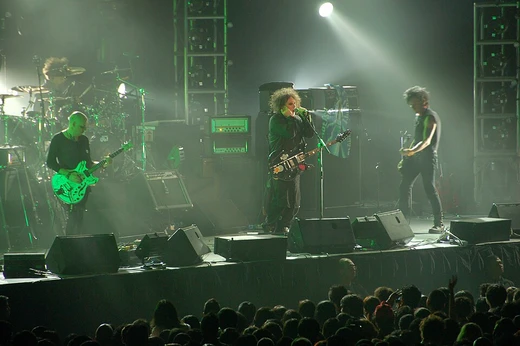
The stage lights dim to a deep, bruised purple. Robert Smith stands at the mic stand, his long curls catching the glow, and the venue—that vast, echoing cathedral of a concert hall—falls into a silence so complete you can hear the hum of the amplifiers. He plucks a single note on his guitar, lets it ring, then another. The crowd, thousands of them, holds its breath. When the first chord of "Just Like Heaven" blooms out, the sound hits the back wall and returns as a wave, and someone in the third row closes their eyes and smiles like they've just remembered a dream they'd been chasing for years. The lights shift to a cold, electric blue. Smith tilts his head, grins that crooked, half-shy grin, and the next song begins—something darker, something from the Disintegration era—and the whole room seems to lean in, drawn into the gravity of it. For three and a half hours, they are all in the same deep water.
Reader's Guide
The original 1992 release on Fiction Records is the anchor of this entry. It gathers roughly a dozen tracks spanning the band's output from the late '70s through 1992, pulling from albums like Three Imaginary Boys, Seven Secret Songs, Pornography, Faith, Kiss Me Kiss Me Kiss Me, Disintegration, and Wish. Highlights include the jangling optimism of "Just Like Heaven," the anxious post-punk of "A Forest" and "Boys Don't Cry," the sweeping melancholy of "Lovesong" and "The Same Deep Water as You," and the bright, propulsive "Friday I'm in Love." The recording context is inherently varied—these are tracks laid down across a dozen-plus years in different studios with different engineers, yet they cohere through Smith's consistent melodic sensibility and the band's signature interplay of jangly guitars and driving rhythms.
Critical reception was broadly positive, framing the album as a long-overdue definitive collection for a band that had never had one. It charted solidly in the UK and found a wide international audience, particularly in Europe and North America, where the band's cult following was still growing.
The 1992 edition sits at a natural midpoint in the band's trajectory: it looks back over the post-punk and art-rock eras while the more accessible, radio-friendly phase was still unfolding. Later reissues (2001, 2010, 2016) refreshed the packaging and, in some editions, expanded the track listing or added bonus material, but the core 1992 selection remains the most widely recognized version. It is the album that still defines "The Cure" for anyone encountering the band for the first time.
Did You Know?
- Fiction Records, The Cure's long-time label, was a small independent operation that gave the band remarkable creative freedom, and the Greatest Hits compilation was one of the label's proudest commercial achievements.
- Robert Smith's iconic look—long, curly black hair, dark clothing—became so synonymous with the band that the visual aesthetic of The Cure is often described as a genre unto itself, influencing countless post-punk and alt
- The band's early albums, particularly Seventeen Seconds and Pornography, are considered landmark works of British post-punk, and tracks from those records appear on Greatest Hits as a reminder of how far the band's sound
- The Cure's live performances are legendary for their atmospheric, almost ritualistic quality, with Smith's stage presence and the band's use of dramatic lighting creating an experience fans often describe as transcending
More in Discography & Albums
Elsewhere in the The Cure universe
Spotted an error? Know more?
This is a living reference — every entry is fact-audited, and reader corrections feed straight into our audit queue. Suggest an edit · See this site's audit record