Out of Mind
A slow, aching arpeggio that turns memory into a wound you can hum.

"Out of Mind" is a 1989 single by the English rock band The Cure, drawn from their landmark seventh studio album *Disintegration*. Written and performed by frontman Robert Smith, the track stands as one of the album's most emotionally restrained and hypnotic moments—a slow-burning, arpeggio-driven meditation on memory, loss, and the quiet ache of feeling disconnected from the people and places you once knew intimately.
As a single, it gave listeners a gentler entry point into the otherwise dense and atmospheric world of *Disintegration*, and it has since become a fixture of The Cure's live repertoire and a frequently cited favorite among fans who appreciate the band's more vulnerable, melodic side.
- Artist
- The Cure (Robert Smith – vocals, guitar, primary songwriter)
- Parent album
- Disintegration (1989)
- Release year
- 1989
- Genre
- Alternative rock / post-punk / art rock
- Role in discography
- Single and album track; one of the more subdued pieces on Disintegration
- Performance
- Regular live staple in The Cure's touring setlists from the late 1980s onward
Lore & Background
In the broader narrative of The Cure's evolution, *Disintegration* marked a deliberate turn inward. After the raw, confrontational energy of *Kiss Me, Kiss Me, Kiss Me* (1987), Robert Smith and the band leaned into longer, more textural compositions. "Out of Mind" sits in that shift: it is less a statement than a whisper, a track that seems to exist in the space between sleeping and waking. Its guitar figure—repetitive, almost ritualistic—evokes the feeling of a thought you cannot quite pin down, circling back on itself with each pass.
Lyrically, the song orbits the idea of emotional estrangement. The narrator looks back on a relationship or a period of life that has slipped beyond reach, and the title phrase captures that specific grief of being present in a place or a person's life yet feeling entirely outside it. It is not a song of rage or dramatic loss; it is the quieter, more insidious pain of slow drift, of watching someone become a stranger while the rooms around you stay the same.
Within the fan community, "Out of Mind" often occupies a special place. Where tracks like "Pictures of You" or "Lullaby" carry the weight of a ballad, this one feels more like a private thought overheard. It is the song fans reach for on long, grey evenings when they want The Cure to feel less like a performance and more like a companion sitting in the next room, playing the same four chords over and over, saying something true without raising their voice.
In Their Own Story
The flat on the top floor of the old boarding house in Crawley had a window that faced the sea, and in the late afternoon the light came in low and gold and made everything look like a photograph from a year that no longer existed. Robert sat at the small upright piano, not playing, just resting his fingers on the keys, listening to the wind pull at the curtains. The guitar case was open on the floor, the instrument half-assembled, a strap still dangling. He had been trying to write a song about a Tuesday—just a Tuesday, the kind where nothing happened and yet everything shifted by a degree you could only feel in your shoulders. He picked up the guitar, found a shape in the arpeggio that felt like breathing out, and the words came not as a story but as a feeling pressed against the inside of his teeth. By the time the tape machine stopped rolling, the light had gone and the sea was just a dark line, and he could not remember whether the song was about someone leaving or about him staying. Both, probably. Both at once. He poured a glass of something cold, set it on the windowsill, and let the last note ring out into the salt air until it was just the wind again.
Reader's Guide
Year: 1989. Parent album: *Disintegration*, The Cure's seventh studio record. The single was issued to give radio and listeners a more accessible window into the album's mood.
Lyrical theme: The song is a quiet, almost elegiac reflection on emotional distance and the slow erosion of closeness. The narrator seems to watch a relationship or a cherished period of life recede, not through a single dramatic rupture but through the accumulation of small absences. The title phrase—being "out of mind"—captures the paradox of someone or something that is technically still present but has become unreachable, a ghost in a room you still occupy.
Musical structure: The track is built around a hypnotic, repeating guitar arpeggio that functions almost like a heartbeat. The arrangement is deliberately sparse compared to the heavier, more layered tracks on *Disintegration*. Verses sit low and close, with Smith's vocal almost conversational, before the chorus opens into a wider, more melodic phrase. The dynamics build slowly and never quite crest into a full explosion, giving the song its characteristic sense of contained emotion. The production is clean and slightly reverb-soaked, letting the guitar figure breathe.
Cultural impact: "Out of Mind" is frequently cited in retrospective "best of" lists and fan polls as one of The Cure's most emotionally resonant mid-tempo tracks. It is often the song that converts listeners who found *Disintegration* too dense, serving as a gentle on-ramp to the album's deeper material.
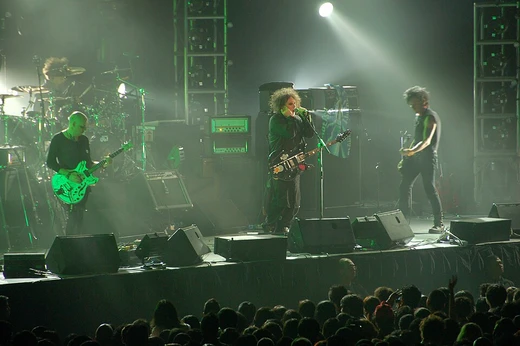
Live performance: The song has been a regular part of The Cure's touring setlists from the late 1980s through the 2020s. In concert, Smith often plays the arpeggio figure with a pick, letting it ring and overlap, and the band tends to keep the arrangement close to the studio version, relying on the space between notes rather than adding ornamentation.
Notable remixes or covers: The track has appeared in various compilation and greatest-hits editions. While it has not been subject to the kind of high-profile remix treatment given to some of The Cure's bigger singles, it has been covered by a small number of independent and tribute artists over the years, typically in stripped-back, acoustic arrangements that highlight the vocal melody.
Did You Know?
- The repetitive guitar arpeggio at the heart of "Out of Mind" is one of the most recognizable melodic figures in The Cure's catalogue, yet the song's structure deliberately avoids a traditional verse-chorus-bridge format,
- On the *Disintegration* album, "Out of Mind" sits between two of the record's more intense and sonically dense tracks, functioning almost as a breather—a moment of stillness in an otherwise relentless sequence.
- Robert Smith has described the writing process for several *Disintegration* tracks as involving long, improvisatory guitar sessions where a single pattern would be played for minutes at a time until a vocal melody or lyr
- The song's title line has become a common phrase in fan communities and social media, often used to describe the specific, quiet sadness of realizing a person or a time has quietly left your life without a single dramati
More in Iconic Songs & B-Sides
Elsewhere in the The Cure universe
Spotted an error? Know more?
This is a living reference — every entry is fact-audited, and reader corrections feed straight into our audit queue. Suggest an edit · See this site's audit record