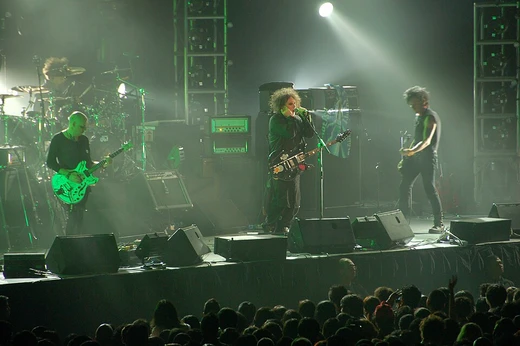
Reading Festival 1984
A shadow-drenched summer night where gothic gloom met festival fire.

The Reading Festival performance of August 1984 stands as a monumental chapter in The Cure's history, marking the band's ascent from post-punk cult heroes to international rock icons. Occurring during the height of their 'The Top' era, just months after the album's release on 22 April 1984, this gig captured Robert Smith and his ensemble at a pivotal creative crossroads, blending gothic melancholy with an emerging danceable energy. For fans, this specific festival appearance is legendary not merely for its musical output, but for the raw, unpolished atmosphere that defined mid-80s British rock. It serves as a time capsule of the band's transition period, where the shadowy aesthetics of their earlier work began to collide with the brighter, more rhythmic sounds that would define their late-eighties dominance.
- Event Type
- Major Music Festival
- Band Status
- Rising International Act
- Associated Album Era
- 'The Top'
- Key Figure
- Robert Smith (Lead Vocals/Guitar)
- Genre Context
- Post-Punk / New Wave / Goth Rock
- Performance Tone
- Energetic, Melancholic, Theatrical
Lore & Background
In the lore of the band's live history, the 1984 Reading appearance is often cited as the moment the 'Cure' sound began to fracture and reassemble into something more expansive. The atmosphere was thick with anticipation. Robert Smith, already an icon in his own right with his signature dark hair and makeup, commanded the stage with a nervous intensity that masked a growing confidence. This performance is remembered as a bridge between two worlds. On one side lay the brooding, bass-heavy textures of their previous years, and on the other, the rhythmic, synth-infused pop that was just beginning to take shape. The band members, including the dynamic interplay between guitarist Porl Thompson and bassist Phil Thornalley's driving lines, created a wall of sound that felt both intimate and massive. It was here that the visual identity of the band—the black suits, the smeared lipstick, the chaotic hair—became fully codified as a movement rather than just a costume. The festival grounds themselves became a backdrop for this evolution. The English summer weather, notoriously unpredictable, seemed to mirror the emotional volatility of the music. Rain or shine, the crowd remained transfixed by a performance that felt less like a concert and more like a shared catharsis, solidifying the bond between the band and their devoted following.
In Their Own Story
The stage lights cut through the evening mist, illuminating a figure standing alone in a pool of blue. Robert Smith adjusted his glasses, the silence of the massive crowd pressing against him like a physical weight. Behind him, the rest of the band tuned up, a low hum of feedback rising into the damp air. As the first chord struck, it wasn't just music; it was a release. The rhythm section kicked in with a driving force that seemed to shake the very ground beneath the festival tents. For three minutes, thousands of people moved as one organism, swaying under the flickering lights, lost in a collective dream of melancholy and hope. When the final note faded into the night, the roar was not just applause, but a declaration that something new had been born.
Reader's Guide
The 1984 Reading Festival took place over three days in August, with The Cure headlining on the final night—Sunday the 25th. The setlist drew heavily from 'Pornography' and 'Faith,' but also previewed the jagged, pop-tinged urgency of 'The Top,' released just months earlier. Bootleg recordings of the show circulate among collectors, capturing the raw, tape-hiss warmth of the PA system and Smith's voice cracking with emotion during 'The Hanging Garden.' For modern fans, the performance offers a rare glimpse of the band at a breaking point: exhausted from touring, yet electric with the tension of reinvention. To experience it fully, cue up the grainy audience footage on YouTube, dim the lights, and imagine the smell of mud, sweat, and cheap cider—the sensory cocktail of a mid-80s British festival.
Did You Know?
- This performance occurred during a transitional phase where the band was experimenting with more rhythmic and dance-oriented sounds before fully embracing them on later albums.
- Robert Smith's visual style, including his distinct makeup and hair, had become so iconic by 1984 that it influenced fashion trends far beyond the music scene.
- The Reading Festival of 1984 is sometimes noted by fans as a memorable performance, though The Cure have consistently rejected the 'goth' label and the show is not historically cited as a defining moment for the subcultu
- Despite the large festival setting, the band maintained an intimate connection with the audience, a hallmark of their live performances throughout their career.
- The setlist included a rare live rendition of 'The Figurehead,' which Smith introduced with a mumbled, half-apologetic comment about it being 'a
More in Tours & Live Performances
Elsewhere in the The Cure universe
Spotted an error? Know more?
This is a living reference — every entry is fact-audited, and reader corrections feed straight into our audit queue. Suggest an edit · See this site's audit record