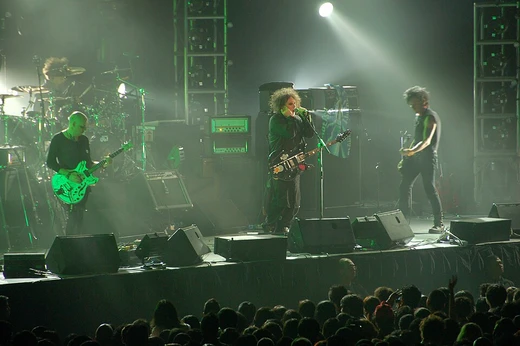
Wild Mood Swings Era (1996)
A chaotic kaleidoscope of sound and emotion.

The Wild Mood Swings Era (1996) marks a turbulent and eclectic chapter in The Cure's discography, defined by the release of their tenth studio album, *Wild Mood Swings*. This period saw the band embrace a deliberately chaotic mix of musical styles, from Latin rhythms and orchestral pop to their signature gothic rock and jangly post-punk. It is often viewed as a transitional and polarizing era, reflecting frontman Robert Smith's exploration of more experimental and upbeat sounds, while still retaining the melancholic core that defines the band's identity.
- Album
- Wild Mood Swings
- Release Year
- 1996
- Band Lineup
- Robert Smith, Simon Gallup, Perry Bamonte, Jason Cooper, Roger O'Donnell
- Genre
- Alternative rock, art rock, pop, experimental
- Label
- Fiction Records (UK), Elektra Records (US)
- Producer
- Robert Smith, Steve Lyon
Lore & Background
The Wild Mood Swings Era emerged after a period of relative stability for The Cure, following the success of *Wish* (1992) and the subsequent tour. The band's lineup had shifted with the departure of guitarist Porl Thompson and the return of keyboardist Roger O'Donnell, alongside new drummer Jason Cooper. This new configuration allowed Robert Smith to experiment with a broader sonic palette, incorporating brass, strings, and world music influences. The album's title itself was a self-aware nod to the erratic nature of the songs, which veered from manic pop to brooding introspection, often within the same track.
In Their Own Story
In a dimly lit studio in the French countryside, Robert Smith stared at a mixing board cluttered with faders and tape reels. The air smelled of stale coffee and cigarette smoke. He had just finished laying down a frantic horn section over a Latin-tinged guitar riff, then immediately switched to a sparse, piano-driven ballad. 'It's like a fever dream,' he muttered to Perry Bamonte, who was tuning a twelve-string guitar. 'One minute you're dancing, the next you're drowning.' The band nodded, knowing that this album would either be their most daring statement or a beautiful mess. Outside, the rain began to fall, matching the mood of the song they were about to record.
Reader's Guide
Sonic Characteristics: The Wild Mood Swings Era is defined by its jarring juxtapositions. Songs shift abruptly from lush orchestral arrangements to raw, distorted guitars. Latin percussion, flamenco flourishes, and brass sections sit alongside classic Cure elements like chiming arpeggios and droning basslines. The production is deliberately uneven, with some tracks feeling polished and others intentionally ragged. Visual Aesthetic: Makeup and fashion remain central, with Robert Smith's smeared red lipstick and teased black hair still iconic. However, the era introduced brighter colors—crimson, gold, and silver—into the band's wardrobe, reflecting the album's more playful moments. The music videos and album art feature surreal, carnivalesque imagery, blending gothic gloom with whimsical chaos. Lyrical Themes: The lyrics swing between manic euphoria and deep despair, often within the same song. Themes of addiction, failed relationships, and existential confusion are explored with a raw, unfiltered honesty. There is a sense of restless searching, as if the narrator is trying on different emotions like costumes. Cultural Impact: While commercially successful, the era divided fans and critics. Some praised its adventurous spirit as a bold leap; others dismissed it as a confused jumble, a band losing its compass. Over time, the album has gained a cult following among those who appreciate its unhinged ambition, its willingness to risk failure for the sake of surprise. It remains a fascinating, messy artifact of a band refusing to play it safe.
Did You Know?
- The album *Wild Mood Swings* was recorded in multiple locations, including a French château and a London studio, contributing to its varied sound.
- The song 'The 13th' features a prominent flamenco guitar part, a first for the band.
- Jason Cooper made his studio debut with The Cure on this album, replacing longtime drummer Boris Williams.
- The album's cover art was created by longtime collaborator Andy Vella, featuring a distorted, colorful face that reflects the album's title.
More in Eras & Musical Styles
Elsewhere in the The Cure universe
Spotted an error? Know more?
This is a living reference — every entry is fact-audited, and reader corrections feed straight into our audit queue. Suggest an edit · See this site's audit record