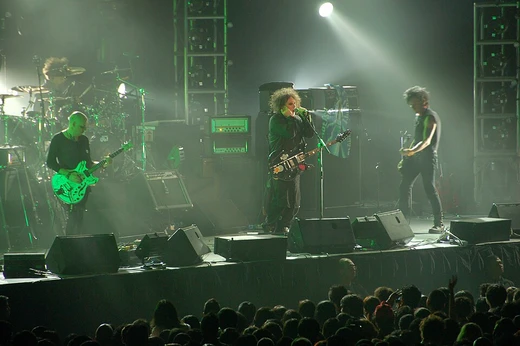
The Pornography Trilogy
Three records charting a slow freeze of the soul — frostbitten numbness on one end, full-throated meltdown on the other.

Three albums — *Seventeen Seconds*, *Faith*, *Pornography* — landed between 1980 and 1982, and fans of The Cure gave them a shared shorthand: the Pornography Trilogy. It's an unofficial label, no executive stamped it on a press release, but it's widely recognized and honestly hard to argue with. The three records form a thematic and sonic triptych that sits right at the dark, introspective core of the band's early gothic period. Production is minimalist, heavy on atmosphere; the lyrics churn through despair, isolation, emotional decay without easing the tone. When people trace the roots of gothic rock they almost always land on these records, and they're the ones that really locked in The Cure's reputation for that brooding, poetic intensity.
- Role
- Thematic album cycle defining the band's early gothic era
- Affiliation
- The Cure's discography (1980-1982)
- First appears
- 1980 with the release of *Seventeen Seconds*
- Status
- Completed trilogy, widely celebrated in fan lore
Lore & Background
The Pornography Trilogy is not an official concept but a fan-driven framework that binds *Seventeen Seconds*, *Faith*, and *Pornography* into a narrative of psychological descent. Each album represents a stage: *Seventeen Seconds* captures the cold, detached observation of a world drained of color—a winter landscape where even the rain feels rehearsed; *Faith* delves into the collapse of belief and the search for meaning in a void, its cathedral reverb echoing off empty pews; *Pornography* is the final, violent implosion—a raw, claustrophobic scream of despair, recorded in a studio so tense that the band members communicated through notes. Together, they trace a journey from numbness to agony to annihilation, with the band's sound evolving from sparse post-punk to dense, suffocating layers of reverb and distortion.
In Their Own Story
The room is dark, lit only by the flicker of a candle guttering in its own wax. A figure sits on the floor, back against a wall, staring at the dust motes dancing in the weak light. The needle drops on a record—the first notes of 'A Reflection' hum through the silence. Outside, rain streaks the window, blurring the streetlights into smears of orange. The figure closes their eyes, and the music wraps around them like a shroud. They are not alone; the shadows in the corners seem to breathe, pulsing with the bassline. This is the world of the trilogy—a place where every sound is a memory, and every silence is a wound.
Reader's Guide
The Pornography Trilogy invites listeners to explore the interplay between sound and meaning. The lyrics are often cryptic, using imagery of rain, cold, and empty spaces to evoke a sense of existential dread. Fans interpret the trilogy as a meditation on the loss of innocence, the failure of faith, and the seduction of despair. The band's visual aesthetic—black clothes, pale makeup, and stark photography—reinforces this mythology, creating a cohesive artistic universe. Each album has its own symbolic language: *Seventeen Seconds* uses time and distance as metaphors for emotional detachment—listen for the ticking clocks and hollow spaces in the mix; *Faith* grapples with religious imagery and the void left by abandoned belief, its cover a ruined church painted by Porl Thompson; *Pornography* confronts the raw, ugly reality of mental breakdown, with Robert Smith's vocals pushed so far forward they feel like a whisper in your ear. The trilogy's power lies in its refusal to offer comfort—it sits with the pain, making it beautiful. For fans, this is not just music but a shared lexicon of grief and resilience, a testament to finding art in the darkest places.
Did You Know?
- The term 'Pornography Trilogy' was coined by fans and later acknowledged by the band, though Robert Smith has expressed mixed feelings about the label, once calling it 'a bit reductive.'
- The album *Pornography* was recorded in a state of extreme tension, with band members barely speaking to each other, contributing to its raw, confrontational sound—the sessions were so fraught that drummer Lol Tolhurst h
- The cover of *Faith* features a painting by Porl Thompson, inspired by a photograph of a ruined church in the English countryside, symbolizing the album's themes of lost belief and hollowed-out sanctity.
- The trilogy's influence extends beyond music, inspiring gothic fashion, literature, and film aesthetics for decades.
More in Lore & Symbolism
Elsewhere in the The Cure universe
Spotted an error? Know more?
This is a living reference — every entry is fact-audited, and reader corrections feed straight into our audit queue. Suggest an edit · See this site's audit record