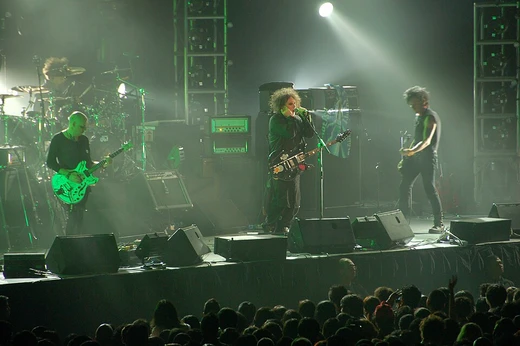
The Hanging Garden
A garden where beauty decays in eternal twilight, and the air smells of damp stone and forgotten prayers.

The Hanging Garden is a haunting, atmospheric track from The Cure's 1982 album *Pornography*, known for its brooding bassline that pulses like a slow heartbeat, sparse guitar notes that hang in the air like cobwebs, and cryptic lyrics that evoke a surreal, decaying paradise. The song's title and imagery draw from a blend of mythological and literary sources, creating a symbolic space where beauty and rot coexist—a place where marble cherubs weep rust and ivy chokes the last trace of color, reflecting the band's exploration of melancholy and existential dread. It stands as a key example of the band's early gothic sound, with its minimalist arrangement and Robert Smith's detached vocal delivery amplifying the sense of eerie stillness, as if the listener is trapped in a dream that refuses to end.
- Role
- Track on the album *Pornography*
- Affiliation
- The Cure
- First appears
- 1982 album *Pornography*
- Status
- Studio recording; occasionally performed live
- Genre
- Post-punk, gothic rock
Lore & Background
The Hanging Garden is often interpreted as a metaphor for a state of suspended animation or a purgatorial realm, where life and death intertwine like the roots of a dying tree. The lyrics speak of 'a place where the sun never shines' and 'a place where the rain never falls,' suggesting a liminal space outside natural cycles—a pocket of eternity where time itself has rusted. Fans and critics have linked the title to the Hanging Gardens of Babylon, one of the Seven Wonders of the Ancient World, but twisted into a symbol of decay: a garden that hangs in a state of perpetual decline, its terraces crumbling, its once-vibrant blooms now blackened husks. This mirrors the album's themes of faith lost and the search for meaning in a barren world, where even the gods have turned their backs. Musically, the track is built around a repetitive, hypnotic bassline that circles like a trapped insect, and sparse, echoing guitar notes that sound like drops of water in a cavern. Robert Smith's vocals are delivered in a low, almost monotone whisper, as if he's speaking from behind a veil of gauze, adding to the feeling of detachment. The song's structure eschews traditional verse-chorus dynamics, instead flowing like a dirge—a slow, inexorable march through a landscape of ash. The production, with its heavy reverb and minimal percussion (just a distant snare and cymbal), gives the track a cavernous quality, as if the listener is standing in an empty, decaying cathedral, the only sound the wind whistling through broken stained glass. The Hanging Garden has become a cult favorite among fans, often cited as a quintessential example of The Cure's ability to create atmosphere through simplicity. Its ambiguous imagery invites multiple readings—some see it as a meditation on depression (the garden as a mind that cannot feel sunlight), others as a commentary on the futility of human endeavor (the garden as a monument to forgotten ambition). The song's enduring appeal lies in its ability to evoke a vivid, unsettling mood without offering easy answers, making it a cornerstone of the band's early gothic aesthetic—a black flower in a field of gray.
In Their Own Story
The garden hangs in silence, its iron gates rusted shut, the hinges groaning only in the memory of wind. Vines crawl over statues of forgotten gods, their faces worn smooth by centuries of rain that never comes, their stone eyes now empty sockets staring into nothing. A single figure stands at the center, where a fountain once flowed—now dry, its basin filled with dead leaves that crackle underfoot like dried skin. The air is thick with the scent of damp earth and something sweet, like rotting fruit, mingled with the faint metallic tang of old iron. The figure does not move, does not breathe, as if the garden itself has frozen time, trapping every molecule in amber. Above, the sky is a perpetual twilight, neither day nor night, casting long shadows that seem to reach for the figure's feet like grasping fingers. Somewhere, a bird calls once—a single, startled note—then falls silent, as if the garden swallowed the sound. The garden waits, as it always has, for something that will never come, its patience the patience of stone.
Reader's Guide
The Hanging Garden is a masterclass in symbolic ambiguity, drawing on the tension between natural beauty and decay. The Hanging Gardens of Babylon, a wonder of the ancient world, were a testament to human ingenuity and desire for paradise. The Cure subverts this, turning the garden into a place of stasis and rot—a paradise lost or never achieved. This reflects the album *Faith*'s exploration of spiritual emptiness and the failure of belief systems. The 'hanging' also suggests suspension, both literal (as in a hanging garden) and metaphorical (as in a hanging state of being), evoking feelings of limbo or purgatory. Fans often interpret the song as a depiction of depression or emotional paralysis, where the world becomes a static, gray landscape. The minimalist music mirrors this, stripping away excess to leave only the essential—a bassline that pulses like a slow heartbeat, guitar notes that fall like drops of water in an empty room. The lack of a traditional melody or chorus reinforces the idea of a cycle that cannot be broken. The song's power lies in its refusal to explain itself, allowing listeners to project their own meanings onto its sparse canvas. It remains a touchstone for those drawn to the darker, more introspective side of The Cure's work.
Did You Know?
- The Hanging Garden was recorded at Morgan Studios in London during the *Pornography* sessions.
- The song's bassline was played by Simon Gallup, whose distinctive style became a hallmark of the band's sound.
More in Lore & Symbolism
Elsewhere in the The Cure universe
Spotted an error? Know more?
This is a living reference — every entry is fact-audited, and reader corrections feed straight into our audit queue. Suggest an edit · See this site's audit record