Gothic Rock Peak (1984-1986)
Where pop hooks rot into beautiful decay.

The Gothic Rock Peak (1984–1986) marks the moment The Cure stopped flirting with darkness and started building a cathedral of it. This is the stretch where Robert Smith’s bat-hair became a global icon, the basslines grew teeth, and the band perfected a sound that could make a dance floor feel like a graveyard at midnight. While *The Head on the Door* (1985) is the era’s anchor—a record that wedded jangling pop hooks to lyrics about drowning in love and waking up dead—the period also includes the *Top* tour’s chaotic energy and the slow-burn shift toward the lush despair of *Disintegration* (1989). This was the moment The Cure stopped being a cult secret and became the high priests of goth, all while Smith’s smeared lipstick and wild hair turned teenage angst into a uniform.
- Era Name
- Gothic Rock Peak (1984-1986)
- Key Albums
- The Head on the Door (1985), Standing on a Beach (1986 compilation)
- Defining Singles
- In Between Days, Close to Me
- Visual Aesthetic
- Big teased hair, smeared red lipstick, black eyeliner, frilly shirts, and a pale, androgynous look
- Cultural Impact
- Defined gothic rock as a mainstream subculture, influencing fashion and music for decades
Lore & Background
By 1984, The Cure was a band held together by frayed nerves and a shared love of shadows. Robert Smith had just survived a near-breakdown and a side gig playing keyboards for Siouxsie and the Banshees—a stint that taught him how to make atmosphere hit like a physical force. The lineup had reshuffled into a core trio of Smith, bassist Simon Gallup (whose lines could sound like a heartbeat slowing down), and drummer Lol Tolhurst, plus guitarist Porl Thompson. Boris Williams had not yet joined; he would come on board for the subsequent tour. They retreated to a converted French farmhouse to record *The Head on the Door*, living together in a haze of wine, fog machines, and late-night experiments. The result was a record that sounded cleaner than anything they’d done before—but the polish only made the dread gleam. "In Between Days" and "Close to Me" became unlikely MTV hits, their catchy melodies masking lyrics about feeling stuck, scared, and half-alive.
In Their Own Story
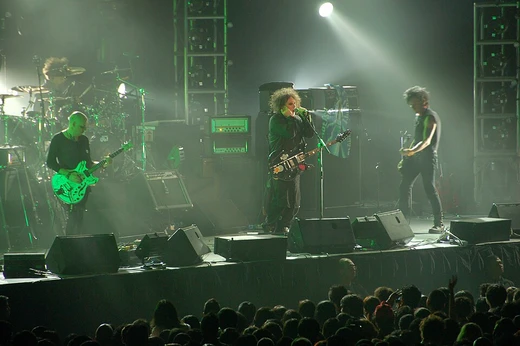
The stage is a fog-choked hall in 1985. A young fan, pressed against the barrier, watches Robert Smith emerge in a black velvet jacket, his hair a wild black halo. The opening chords of "A Night Like This" ripple through the crowd, and the fan feels the bass in her chest. Smith's voice, half-mumbled, half-sung, weaves a spell of beautiful despair. She closes her eyes, and for three minutes, the world outside—the school bullies, the parents who don't understand—fades into the smoke. This is her church, and the Cure are its high priests. The song ends, and for a moment, the silence is louder than any scream. Then the first notes of "Close to Me" hit, and the crowd surges, a sea of black lace and backcombed hair, dancing like the end of the world is something to celebrate.
Reader's Guide
Sonically, this era is a tightrope walk between a pop hook and a funeral march. The guitars jangle like broken wind chimes, the basslines prowl like something hungry, and the drums can switch from a danceable pulse to a slow, crushing dirge in a single bar. *The Head on the Door*’s production is cleaner than earlier records, letting Smith’s layered vocals—sometimes a whisper, sometimes a wail—float over the chaos. Synthesizers appear sparingly, like frost on a windowpane, adding a cold shimmer to tracks like "Screw" and "The Baby Screams."
Visually, the gothic aesthetic reached its iconic form: hair backcombed into a black storm cloud, lipstick smeared like a fresh wound, eyeliner heavy enough to look like permanent exhaustion. Black clothes, frilly shirts, velvet jackets—this was a uniform that said "I’ve seen the void, and it’s wearing the same thing I am." It was a rebellion against the neon-and-shoulder-pads 80s, a nod to Romantic poets and horror movies, and a signal to every outsider: you’re not alone. Lyrically, Smith wrote about love as a trap, happiness as a lie, and dread as a constant companion. His words are poetic but never pretentious—they hit like a punch to the gut, then linger like a bruise. Culturally, this era turned The Cure into the face of goth, influencing fashion, music, and even film. Their look and sound became shorthand for a certain kind of beautiful misery, a brand of darkness that felt both personal and universal.
Did You Know?
- Robert Smith's iconic bat-hair was achieved by backcombing and using copious amounts of hairspray—a look he said was partly inspired by the Bride of Frankenstein.
- The Head on the Door was recorded in a converted French farmhouse, where the band lived together, drank cheap wine, and recorded late into the night, giving the album a lived-in, claustrophobic feel.
- The music video for 'Close to Me' featured the band playing in a tiny, claustrophobic room that was actually a wardrobe—Smith later said it felt like being buried alive, which was exactly the point.
- This era saw the band's first major US breakthrough, with 'In Between Days' and 'Close to Me' getting heavy MTV airplay, introducing a generation of suburban teens to the sound of their own anxiety.
More in Eras & Musical Styles
Elsewhere in the The Cure universe
Spotted an error? Know more?
This is a living reference — every entry is fact-audited, and reader corrections feed straight into our audit queue. Suggest an edit · See this site's audit record