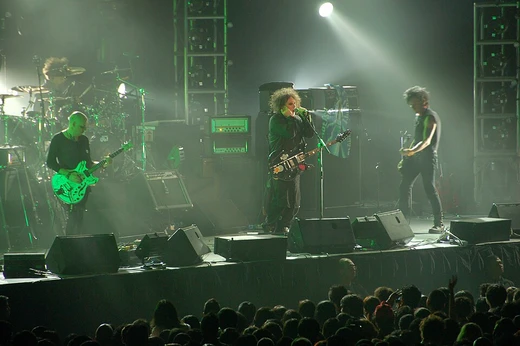
Just Like Heaven
A kiss that tastes like salt spray and forever.

Eva Rinaldi · CC BY-SA 2.0
"Just Like Heaven" is a song by English rock band the Cure, released as the third single from their 1987 album Kiss Me, Kiss Me, Kiss Me. The song became the Cure's first American hit, reaching number 40 on the Billboard charts in 1988. The lyrics were written by frontman Robert Smith, who drew inspiration from a past trip to the sea shore with his future wife, Mary Poole. Smith has said he considers "Just Like Heaven" to be one of the band's strongest songs, calling it "the best pop song the Cure have ever done."
- B-Side
- Breathe (originally recorded during the sessions for 'The Top' and first released as the B-side to 'The Lovecats' in 1983)
Verified Timeline
Lore & Background
The song's lyrics were inspired by a trip with Smith's then-girlfriend (and later wife) Mary Poole to Beachy Head in southern England. Smith said the opening line of the song ("Show me, show me, show me how you do that trick") refers to his childhood memories of mastering magic tricks, but added "on another [level], it's about a seduction trick, from much later in my life." The music video, directed by Tim Pope, was filmed in England's Pinewood Studios in October 1987. Set on a cliff overlooking a sea, the video recreates many of the memories detailed in the song's lyrics. While Smith claimed for years that the video was shot at the same place that inspired the song, he later admitted that the bulk of it was filmed in a studio, utilising footage of the water and cliffs of Beachy Head taken for the band's 1985 video for "Close to Me." Mary Poole appears in the video as a woman dressed in white dancing with Smith. As Smith explained, "Mary dances with me in the video because she was the girl [in the song], so it had to be her."
In Their Own Story
The rain had stopped, but the sea still churned, gray and endless. On the cliff's edge, Robert stood, his guitar humming a melody that felt like the wind itself. He watched Mary's hair whip across her face as she laughed, and in that instant, the world seemed to pause—a perfect, fragile bubble. He scribbled the words on a napkin later, knowing the song would never capture the salt spray or the way her eyes reflected the storm, but hoping it might come close. The band gathered in the studio, and Boris's drums crashed like waves, Simon's bass a steady tide. When they finished, they knew they had caught something rare: a moment of pure, aching beauty, bottled in sound.
Reader's Guide
"Just Like Heaven" is written in the key of A major and consists of an A–E–Bm–D chord progression which repeats throughout the song, except during the chorus when the band plays an F♯m–G–D progression. The song's central hook is formed from a descending guitar riff which appears between song verses and in parts of the bridge and the last verse. This guitar line contrasts with the "fuzzier mix" of the rhythm guitars. According to Smith, "The song is about hyperventilating—kissing and fainting to the floor." The song was the Cure's eleventh top 40 hit in the UK, and stayed on the charts there for five weeks during October and November 1987, peaking at number 29. In the United States, "Just Like Heaven" became the Cure's first top 40 hit when it reached number 40 on the Billboard Hot 100 for one week in December 1987. Robert Smith's personal favourite cover is the one recorded by American alternative rock band Dinosaur Jr., which was released as a single in the UK in 1989. Smith said, "J Mascis sent me a cassette, and it was so passionate. It was fantastic. I've never had such a visceral reaction to a cover version before or since."
Did You Know?
- Before Smith had completed the lyrics, an instrumental version of the song was used as the theme for the French television show Les Enfants du Rock.
- The song's opening line ('Show me, show me, show me how you do that trick') refers to Smith's childhood memories of mastering magic tricks.
- Mary Poole, Smith's then-girlfriend and later wife, appears in the music video dancing with Smith — Pope later commented that Poole 'can honestly lay claim to being the only featured female in any Cure video, ever.'
- On 16 July 2006, 'Just Like Heaven' was played as a wake-up call for the crew of Space Shuttle Discovery on their flight STS-121 at the request of astronaut Piers Sellers' family.
- Robert Smith's personal favourite cover of the song is by Dinosaur Jr., which he said 'influenced how we play it live.'
Creative Genesis and Production
In order to develop material for Kiss Me, Kiss Me, Kiss Me, Smith forced himself to write music for 15 days of each month. During this regimen, he developed the chords and melody which form the basis of "Just Like Heaven." Structurally, Smith found what he had written was similar to the Only Ones's 1979 hit "Another Girl, Another Planet." When he brought an instrumental demo of the song to the album recording sessions in Southern France, Cure drummer Boris Williams increased the tempo and added an opening drum fill which inspired Smith to introduce each instrument singularly and in sequence. When the French TV show Les Enfants du Rock asked the Cure to provide a theme song, Smith offered the instrumental version. As he explained, "It meant the music would be familiar to millions of Europeans even before it was released." He completed the lyrics when the group moved the sessions to Studio Miraval, located in Le Val, Provence-Alpes-Côte d'Azur. The band completed the song quickly, and at the time Smith considered it to be the most obvious potential single from the songs the band had recorded during their two-week stay at Miraval.
Musical Composition and Lyrical Themes
Musically, the song is anchored in A major, utilizing a repeating A–E–Bm–D chord progression that shifts to F♯m–G–D during the chorus. The arrangement features a central descending guitar riff that serves as the primary hook, appearing between verses and within the bridge. This clean, chiming melody stands out distinctly against the fuzzier texture of the rhythm guitars, while Simon Gallup's bass and Boris Williams' drums provide a powerful foundation. Lyrically, Smith describes the song as capturing the sensation of hyperventilating from intense kissing until fainting. The words were inspired by a specific trip to Beachy Head with his then-partner Mary Poole, who would later become his wife. The opening line references childhood memories of learning magic tricks but operates on a deeper level regarding seduction techniques in adulthood. Smith has noted that these personal recollections also formed the narrative basis for the song's accompanying music video.
Critical Reception and Chart Performance
Released as the third single from their 1987 album, the track achieved significant commercial success, particularly marking a breakthrough in the United States where it became the band's first top forty hit on the Billboard Hot 100. In the UK, it secured an eleventh top forty position for the group, peaking at number twenty-nine and remaining on the charts for five weeks. Critical response was largely enthusiastic; AllMusic critics praised its memorable energy and romantic wistfulness, highlighting how the instrumentation perfectly showcased Smith's songwriting abilities. Slant Magazine described it as a stellar example of the band at their peak, citing the glistening guitar lines and authoritative drumming. While later singles achieved higher chart positions, this track is often cited as the definitive Cure song for American audiences. Its enduring quality was recognized by major publications, with Rolling Stone ranking it among the greatest songs of all time across multiple lists, and Entertainment Weekly celebrating its status as a premier love song.
Enduring Legacy and Cultural Impact
Decades after its release, the song remains one of Robert Smith's most cherished compositions, which he has called the best pop song the band ever produced. Its influence extends far beyond rock radio, inspiring high-profile musicians like Ben Folds and J Mascis of Dinosaur Jr., who recorded a cover version in 1989 due to their deep affection for the track. The song's cultural footprint is evident in its use as a wake-up call for astronauts aboard Space Shuttle Discovery in 2006, evoking memories of youthful freedom for crew member Piers Sellers. It also lent its title and soundtrack presence to the 2005 film Just Like Heaven. Over time, various music publications have consistently ranked it highly; Billboard named it the greatest Cure song in 2019, while Mojo placed it fourth on their list of the band's best tracks in 2023. This sustained acclaim confirms its status as a timeless anthem that transcends its late-eighties origins.
Gallery
Frequently Asked Questions
Which album features Just Like Heaven?
The song is a standout track from the 1987 album Kiss Me, Kiss Me, Kiss Me. It helped solidify the band's presence in the alternative rock scene during that era.
Who are the credited songwriters?
Robert Smith co-wrote the piece with Simon Gallup, Porl Thompson, Boris Williams, and Lol Tolhurst. This lineup reflects the collaborative nature of the band at the time.
What B-side accompanies this single release?
Fans can find the track Breathe on the flip side of the single. Both recordings were created during the same studio sessions.
What musical style does the song represent?
It blends dream pop elements with shimmering guitar work and romantic themes. This mix is often cited as a hallmark of the group's signature sound.
Who produced the recording?
David M. Allen and Robert Smith shared production responsibilities for the track. Their collaboration ensured the final mix retained a polished yet emotional quality.
More in Iconic Songs & B-Sides
Elsewhere in the The Cure universe
Spotted an error? Know more?
This is a living reference — every entry is fact-audited, and reader corrections feed straight into our audit queue. Suggest an edit · See this site's audit record