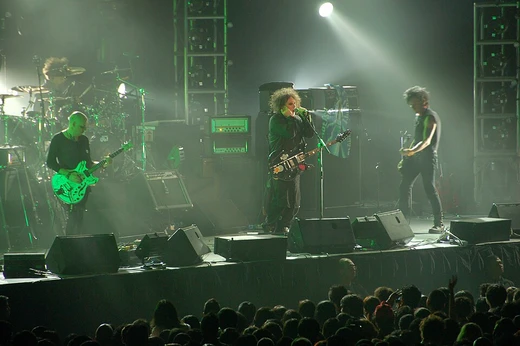
Glastonbury Festival headlining set 1990
Black hair, muddy fields, and a nation singing 'A Forest' under a Somerset sky.

The Cure's headlining performance at the 1990 Glastonbury Festival stands as one of the band's most celebrated live appearances, delivered at the height of the Disintegration era. Coming just a year after the release of their critically adored 1989 album, the set showcased the band at a creative peak while also reflecting the emotional turbulence that had fueled the record's darker material.
Set against the sprawling, muddy fields of Worthy Farm in Pilton, Somerset, the performance captured the full spectrum of The Cure's identity: the gothic grandeur of Robert Smith's stage presence, the layered interplay of multiple guitars and keyboards, and the communal, almost ritualistic energy of a festival crowd singing along to songs that had defined a generation. For fans, it remains a touchstone moment in the band's live history.
- Event
- Glastonbury Festival 1990 – Headlining Set
- Location
- Worthy Farm, Pilton, Somerset, England
- Era / Album context
- Disintegration (1989) touring period
- Frontman
- Robert Smith
- Festival slot
- Headliner
- Setting
- Outdoor festival, main stage
Lore & Background
By the summer of 1990, The Cure had just navigated one of the most emotionally fraught creative periods in their history. The Disintegration sessions had been marked by personal crisis, and the resulting album—haunting, orchestral in its arrangements, and deeply melancholic—had been met with near-universal critical praise. Stepping onto the Glastonbury stage, the band carried that weight: a record that demanded patience and emotional depth from its audience, performed in front of tens of thousands who had come for a weekend of celebration.
The performance embodied the duality that had always defined The Cure's live shows. Robert Smith, with his signature tangle of black hair, heavy eyeliner, and dark attire, moved through the set with a physical intensity that contrasted sharply with the songs' restrained, aching melodies. The interplay between the twin guitarists and the keyboard textures created a wall of sound that filled the open-air space, while the bass and drum foundation kept the arrangements grounded and driving. Older material from the band's catalogue sat alongside the newer, more somber compositions, giving the crowd a full emotional arc from euphoric to devastating.
In the broader context of the band's career, the 1990 Glastonbury set represented a bridge between the raw, post-punk energy of their early years and the more polished, atmospheric production that would define their subsequent work. It was a performance where the audience's collective voice—thousands of voices rising in unison on the choruses—became an inseparable part of the music itself, a phenomenon that fans of The Cure have long described as almost spiritual in its intensity.
In Their Own Story
The last light was bleeding out over the Somerset hills, turning the sky the colour of a bruise. Robert stood at the mic, feeling the vibration of the crowd's hum through the soles of his boots—thousands of people, packed into the mud, waiting. The guitarist beside him tuned a string; the keyboardist's fingers hovered over the keys like a pianist about to begin a nocturne. He could smell the wet earth, the diesel from the generator trucks, the faint sweetness of someone's cheap beer two rows back. He closed his eyes. When he opened them, the first chord fell like a stone into still water, and the whole field exhaled. For the next hour, there was no Pilton, no festival, no year. There was only the sound, the dark, and the ten thousand voices becoming one. He would remember the mud on his shoes for weeks. He would not remember the date.
Reader's Guide
The 1990 Glastonbury headlining set took place on the main stage at Worthy Farm in late June 1990, during the festival's peak summer slot. The Cure were at the top of their Disintegration-era touring cycle, having spent the preceding months playing arenas and theatres across the UK and Europe.
The setlist drew from the full breadth of the band's catalogue: the orchestral, guitar-drenched material of Disintegration sat alongside earlier fan favourites, giving the audience a journey from the band's post-punk roots to their most cinematic, layered arrangements. Songs like 'A Forest,' 'Just Like Heaven,' and 'Pictures of You' were staples of the era's live shows, and the Glastonbury performance followed the same broad structure the band had refined over months of touring.
Stage design for a festival headlining slot of this era was comparatively restrained by modern standards: a wide platform, multiple guitar amps, a keyboard station, and the band's characteristic dark visual palette. The open sky and the natural landscape of Worthy Farm provided the backdrop, and the sheer scale of the crowd—tens of thousands across the main field—gave the performance a communal, almost ceremonial quality.
The set was notable for the band's ability to command a festival audience that had come for a wide variety of acts, drawing them into a more introspective, emotionally charged experience. It remains a reference point in The Cure's live history for the way it balanced their darker material with the anthemic, singalong moments that made a festival crowd feel like a single organism.
Did You Know?
- The Disintegration album, which anchored the 1990 touring set, was recorded during a period of intense personal difficulty for Robert Smith, and the band's live performances of that era carried a palpable emotional weigh
- Glastonbury's Worthy Farm site in Somerset has hosted the festival since 1970, and by 1990 it had already established its reputation as one of the UK's most important summer music events, making a headlining slot a signi
- The Cure's live sound in this era relied heavily on the interplay between two guitarists and a dedicated keyboardist, creating layered, almost orchestral textures that were a defining feature of their stage shows through
- Robert Smith's on-stage appearance—long black hair, heavy eye makeup, dark clothing—had become one of the most recognisable visual signatures in British rock by 1990, and his physical, almost theatrical engagement with t
More in Tours & Live Performances
Elsewhere in the The Cure universe
Spotted an error? Know more?
This is a living reference — every entry is fact-audited, and reader corrections feed straight into our audit queue. Suggest an edit · See this site's audit record