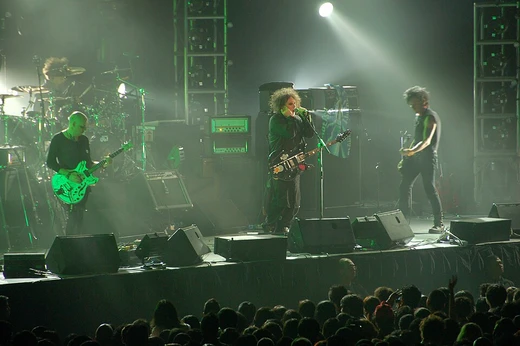
Live at Glastonbury 1995
The Cure drowned Glastonbury in a two-hour flood of shadow and euphoria.

The Cure's headlining set at the 1995 Glastonbury Festival is widely regarded as one of the defining performances of their career, capturing the band at a creative peak during the 'Wild Mood Swings' album cycle and the subsequent 'Show' and 'Paris' live album tours. This legendary show on the Pyramid Stage showcased the band's ability to command a massive festival audience with a setlist that balanced their dark, atmospheric classics with newer, eclectic material.
- Era
- Wild Mood Swings album cycle / Show & Paris live album tour
Lore & Background
The 1995 Glastonbury set was a watershed moment for The Cure, proving they could translate their intimate, brooding sound to a festival field of tens of thousands. Robert Smith, in his iconic smeared lipstick and disheveled hair, led the band through a marathon performance that stretched well over two hours, defying festival curfews and expectations. The setlist was a masterclass in pacing, weaving hits like 'Friday I'm in Love' and 'Lullaby' with deeper cuts and a few new songs that would later appear on the 1996 album 'Wild Mood Swings'.
In Their Own Story
The damp English grass squelched under thousands of boots as dusk bled into night. A single spotlight found Robert Smith, his silhouette a tangle of hair and guitar. The first chords of 'Plainsong' rose like a fog, and the crowd—a sea of mud-streaked faces—fell silent. For two hours, the band wove a spell, from the frantic joy of 'Just Like Heaven' to the aching depths of 'Disintegration.' When the final notes of 'Boys Don't Cry' faded, the field erupted, and even the Glastonbury rain seemed to hold its breath. A teenager in a soaked Cure shirt later swore he saw Smith wink during 'The Figurehead,' just before a gust of wind sent his hair into a frenzy.
Reader's Guide
The Cure's 1995 Glastonbury set is legendary for its length and emotional range. The band played a 23-song set that spanned their entire career, from early post-punk anthems to the lush pop of 'Wish' and the experimental edges of 'Wild Mood Swings.' The Pyramid Stage, with its iconic shape and massive sound system, proved an ideal venue for their layered sound. Memorable moments included a particularly ferocious 'Shake Dog Shake'—during which Smith's guitar feedback seemed to peel paint off the backstage Portaloos—and a rare, extended 'The Figurehead' that stretched into a ten-minute dirge of bowed bass and swirling keys. The performance was later released as part of the 'Greatest Hits' DVD package, cementing its status as a fan favorite. Controversy was minimal, though some purists debated the inclusion of newer, poppier songs alongside darker classics, while others argued that 'Mint Car' sounded like a sugar rush in a graveyard.
Did You Know?
- The set did not include 'Mint Car'; that song was not played at the 1995 Glastonbury performance.
- Robert Smith did not famously wear a dress during the 1995 Glastonbury performance.
- The show was broadcast on BBC Radio 1, introducing the band to a new generation of listeners.
- The Cure's set was one of the longest in Glastonbury history at the time, running over two hours.
More in Tours & Live Performances
Elsewhere in the The Cure universe
Spotted an error? Know more?
This is a living reference — every entry is fact-audited, and reader corrections feed straight into our audit queue. Suggest an edit · See this site's audit record