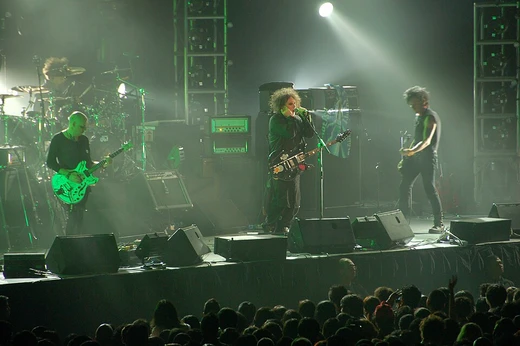
Robert Smith
The boy with the dark hair who turned a generation's quiet ache into a cathedral of sound.

Robert Smith is the creative engine, visual icon, and sole permanent member of The Cure, the English post-punk band formed in Crawley, Sussex, in 1976. As lead vocalist, guitarist, and primary songwriter, Smith has shaped every album the band has released across nearly five decades, steering their sound from the jangly optimism of their early work through the crushing darkness of their mid-period and into the sprawling, orchestral melancholy of their later records. In fan culture, he is less a frontman than a living symbol: the long dark hair, the heavy eyeliner, the hunched guitar posture—these have become shorthand for an entire emotional vocabulary of longing, alienation, and fragile beauty.
This entry treats Smith not merely as a musician but as the central figure in The Cure's mythology: the boy who writes songs about boys who can't quite reach the girl on the other side of the glass, the man who turns personal grief into communal ritual, and the artist whose very appearance became a shared language for a generation of listeners who felt they didn't fit neatly into the world.
- Role
- Lead vocalist, guitarist, primary songwriter
- Affiliation
- The Cure (sole permanent member)
- Formed
- 1976, Crawley, West Sussex, England
- Genre
- Post-punk / gothic rock / art rock
- Status
- Active (latest album: Songs of a Lost World, 2024)
- Born
- 1956, Crawley, England
Lore & Background
Robert Smith's position within The Cure is unlike that of most frontmen. He is not merely the face or the voice; he is the through-line. Every lineup change, every shift from the bright, bouncy pop of the early days to the suffocating reverb of the mid-period and back to the wide, aching openness of the later work, passed through his hands and his guitar. Fans often describe the experience of a Cure concert as attending a séance conducted by a single, slightly bewildered boy who has been writing the same love letter to the same unreachable person for forty years, and somehow each new draft still makes you weep.
Smith's songwriting operates in a symbolic key that fans have spent decades decoding. The recurring figures—the boy, the girl, the man in the mirror, the figure on the beach—function less as characters than as emotional states. The 'Cure' themselves became a kind of secular church: their lyrics provided a vocabulary for feelings that had no other name. To be a 'Cure kid' in the 1980s was to find, in a band from a small Sussex town, permission to be sad, strange, and tender all at once, and to discover that those things were not contradictions but a single, coherent self.
His visual identity—those cascading black curls, the thick kohl-rimmed eyes, the preference for dark, often rumpled clothing—was never merely a costume. It was a statement of emotional honesty in a scene that often performed coolness. Smith looked like he had just cried, and in a way, he always had. That unguardedness became the band's most powerful instrument, more resonant than any amplifier.
In Their Own Story
The dressing room smells of hairspray and cold tea. Outside, the arena hums with a low, electric murmur—thousands of people who have driven six hours, who have pressed their palms against the glass of a van window on a rainy Tuesday in 1984 and decided that this was the sound their insides made. Smith sits on a battered leather chair, his hair a dark curtain that hides his face from the mirror. He runs a thumb over the worn neck of his guitar, testing the intonation of the low string. He does not need to. He knows where every note lives. A roadie sets a glass of water on the table; Smith does not look up. He is already inside the first chord of the next song, the one about the boy who stands on the beach and watches the light go out and cannot, for the life of him, decide whether to call out or to let the silence have its way. The arena lights dim. The murmur swells into a roar. And the boy with the dark hair walks out into it, and the world, for four or five minutes, is exactly as sad and beautiful as it needs to be.
Reader's Guide
The name 'Cure' itself is the first and most enduring symbol. Smith has described it as a suggestion from a friend, chosen partly for its brevity and partly for its quiet irony: a band called 'The Cure' whose songs are, more often than not, about the illness. Fans read it as a paradox that holds the whole mythology together—the act of singing the wound is itself the healing, and the healing never quite closes the wound. It is a loop, and the loop is the point.
The long, dark, frizzy hair is perhaps the most immediately recognizable visual signifier in post-punk history. It began as a practical, slightly accidental look in the mid-1970s and grew into a kind of living emblem. Across albums, the hair thickened, darkened, and became more elaborate, reaching its most dramatic length during the mid-period. Fans treat it as a barometer: the longer and wilder the hair, the darker and more immersive the music. Smith has acknowledged its symbolic weight without ever fully codifying it, which is very much in keeping with his approach to meaning.
The eyeliner and the dark, rumpled wardrobe function as a kind of emotional punctuation. In a genre landscape that often performed swagger or cool detachment, Smith's look said: I am not performing. I am simply here, and I am sad, and I am not ashamed of it. That unguardedness became a shared language. The jangle guitar tone—bright, chiming, slightly out of focus—serves as the sonic counterpart: it sounds like sunlight through a window in a room where someone is crying. Together, the visual and the aural create a symbolic grammar that fans have read, reread, and argued over for nearly fifty years, and that still, somehow, feels like it is being written in real time.
Did You Know?
- Robert Smith is the only member to have been present in every iteration of The Cure from its 1976 formation to the present, making him the band's sole living constant across nearly five decades of lineup changes.
- The band's name, 'The Cure,' was reportedly suggested by a friend rather than chosen by Smith himself, and he has acknowledged the gentle irony of a group called 'the cure' whose songs so often dwell on the ache itself.
- Smith's distinctive long, dark hair and heavy eyeliner became so closely identified with the band's identity that the look is often used in fan art and merchandise as a shorthand for The Cure even when no band name or lo
- The Cure's songwriting frequently returns to the image of a boy or a figure standing at a threshold—a beach, a window, a door—watching someone or something just out of reach, a motif fans have come to read as the band's
More in Lore & Symbolism
Elsewhere in the The Cure universe
Spotted an error? Know more?
This is a living reference — every entry is fact-audited, and reader corrections feed straight into our audit queue. Suggest an edit · See this site's audit record