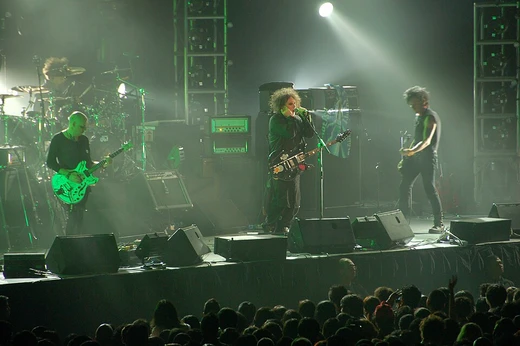
Post-Punk (1979-1982)
The birth of darkness: sparse, cold, and deeply human.

The Post-Punk era of The Cure, spanning from 1979 to 1982, marks the band's formative years as they emerged from the ashes of the punk scene into a darker, more introspective sound. This period saw the release of their first four albums—Three Imaginary Boys, Seventeen Seconds, Faith, and Pornography—along with the lead single 'A Forest' from Seventeen Seconds, which became a defining track. It established the band's signature blend of sparse guitar work, brooding basslines, and Robert Smith's haunting vocals, laying the groundwork for their later gothic rock identity. But this was no mere blueprint; it was a slow, deliberate unmaking—a stripping away of punk's brashness until only cold, echoing bones remained.
- era_name
- Post-Punk (1979-1982)
- key_albums
- Three Imaginary Boys, Seventeen Seconds, Faith, Pornography
- key_members
- Robert Smith, Simon Gallup, Lol Tolhurst, Matthieu Hartley
- defining_single
- A Forest
- sonic_markers
- Minimalist guitar, driving bass, atmospheric keyboards, reverb-heavy production
- visual_aesthetic
- Dark clothing, smudged eyeliner, disheveled hair, stark black-and-white imagery
Lore & Background
In the late 1970s, The Cure emerged from Crawley, England, as a punk-influenced trio with Robert Smith, Michael Dempsey, and Lol Tolhurst. Their debut, Three Imaginary Boys, reflected a quirky, post-punk energy, but by 1980's Seventeen Seconds, the band had shed its playful edge for a more minimalist, melancholic sound. The departure of Dempsey and addition of Simon Gallup on bass and Matthieu Hartley on keyboards deepened the atmospheric gloom, culminating in the stark, cathedral-like textures of Faith (1981). This era is often seen as the band's 'cold' period, where Smith's lyrics explored isolation, time, and existential dread, set against sparse arrangements that felt like empty spaces echoing with emotion. Legend has it that during the Faith sessions, the studio lights were kept off—not for ambiance, but because the band felt that darkness was the only honest way to shape such hollow, resonant sounds.
In Their Own Story
The rain fell in sheets over the small club, but inside, the air was dry and thick with smoke. A young Robert Smith stood at the mic, his eyes ringed with black, his voice a fragile whisper over the slow pulse of Simon Gallup's bass. The crowd swayed, lost in the reverb of 'A Forest,' a song that felt less like music and more like a memory of a dream. For a moment, the world outside—the punk chaos, the neon lights, the angry slogans—faded into a single, cold note that hung in the air like a question no one dared answer. When the final chord decayed into silence, no one clapped at first; they just stood there, as if waking from a trance, unsure whether they had heard a song or a confession.
Reader's Guide
Sonic characteristics: Sparse, minimalist arrangements with prominent basslines, clean but reverb-drenched guitars, and atmospheric keyboards (especially on Faith). Rhythms are often slow and hypnotic, with Smith's vocals delivered in a detached, almost whispered tone. Production is dry and cold, emphasizing space over density. Visual aesthetic: Dark, monochromatic clothing—black shirts, tight trousers, and long coats. Smith's early look featured messy hair, minimal makeup (smudged eyeliner), and a pale complexion, evolving from punk spikiness to a more romantic, disheveled gothic appearance by 1982. Lyrical themes: Isolation, time, memory, existential despair, and the search for meaning in a bleak world. Songs like 'Seventeen Seconds' and 'Faith' deal with the passage of time and loss of innocence, while 'A Forest' explores fear and the unknown. Cultural impact: This era defined the 'cold wave' sound and heavily influenced the emerging gothic rock genre. The Cure's post-punk work inspired countless bands in the 1980s and beyond, from Joy Division to modern shoegaze, and established a template for introspective, atmospheric rock that prioritized mood over aggression.
Did You Know?
- The album 'Faith' was recorded over several months, with the band often working in near-darkness to capture a specific mood.
- The iconic cover of 'Seventeen Seconds' features a simple, stark image of a single flower against a black background, reflecting the album's minimalist aesthetic.
- During this era, Robert Smith famously refused to smile in photographs, reinforcing the band's serious, brooding image.
- The song 'A Forest' was originally written as a short, punk-influenced track before being expanded into its atmospheric, five-minute version.
- Simon Gallup's bassline on 'A Forest' was reportedly played with a pick dipped in reverb, giving it that cold, dripping quality that defined the era.
More in Eras & Musical Styles
Elsewhere in the The Cure universe
Spotted an error? Know more?
This is a living reference — every entry is fact-audited, and reader corrections feed straight into our audit queue. Suggest an edit · See this site's audit record