The Headmaster
The voice from the office that tells you to stop feeling so much.

The Headmaster is not a named character in any single Cure track or album, but rather a recurring symbolic figure that fans have come to associate with the band's sustained preoccupation with institutional authority, emotional suppression, and the cold machinery of control. Across Robert Smith's songwriting, the Headmaster functions as the archetypal 'other'—the figure who enforces rules, polices feeling, and represents the world that demands a young person conform before they are allowed to grieve, rage, or simply exist.
In fan-encyclopedic terms, the Headmaster sits alongside other Cure-adjacent symbols (the Cross, the X, the Mask, the Moth) as a motif rather than a plot element. He is the grey corridor, the closed door, the voice from the office that says *sit down, be quiet, stop feeling so much*. He is what the Cure's protagonists are perpetually fleeing from or confronting in the dark.
- Type
- Thematic motif / symbolic figure
- Role
- Embodiment of institutional authority and emotional suppression
- Affiliation
- Recurring across multiple albums as a lyrical and visual theme
- Status
- Ongoing symbolic presence, never 'defeated' or resolved
- Associated imagery
- Grey institutional interiors, closed doors, the figure behind glass
Lore & Background
The Cure's catalogue is, at its emotional core, a long argument against the people and systems that insist feeling is a disorder. The Headmaster crystallises that argument into a single, faceless authority. He is not a villain in the theatrical sense; he is the fluorescent-lit room, the clipboard, the sentence handed down without explanation. Robert Smith has spoken in interviews about growing up in a post-war English milieu where emotional expression was treated as weakness, and that personal history bleeds into the band's fiction. The Headmaster is what that milieu looks like when you give it a coat and a desk.
Musically, the motif tends to surface in the more angular, staccato passages—the clipped rhythms of the early albums where the drums hit like a metronome in a classroom, or the cold, reverb-drenched guitar lines of the mid-period work where the protagonist is locked in a room with no window. The Headmaster does not monologue; he simply *is*, a pressure in the architecture of the song. Fans often point to the way certain tracks feel like a character walking down a long institutional corridor, the footsteps echoing, the door at the end slowly closing.
What makes the Headmaster enduring in fan interpretation is his refusal to be specific. He could be a school, a church, a government, a parent, a doctor, a god. The Cure never pin him down, and that deliberate vagueness is part of his power. He is the universal 'no' that a young person hears before they learn to say 'yes' to themselves.
In Their Own Story
The corridor smells of wet wool and floor polish. You have been standing outside the office for eleven minutes, though it feels like an hour. The door is mahogany, unmarked, and behind it a radiator ticks in a rhythm that is almost, but not quite, a heartbeat. You press your forehead to the wood. On the other side, a chair scrapes. A pen clicks. The silence that follows is the loudest sound in the building. You do not knock. You do not need to. You already know what will be said: *You are not well. Sit down. We will fix you.* And you will sit. And you will smile. And you will walk back to your desk and open your book and pretend the words mean something. But in your pocket, your fingers are still cold, and the X you drew on your notebook that morning is smearing, bleeding into the margin like a small, red wound that no one will notice until it is too late.
Reader's Guide
The Headmaster as a symbol is best understood through the institutional imagery that threads through the Cure's visual and lyrical world. In the early years, the band's aesthetic leaned heavily on the school uniform, the cross, the chalkboard—signifiers of a childhood governed by rules that had no explanation. Robert Smith has described in interviews how the school and the church were the two great engines of emotional policing in his formative years, and that duality—sacred and secular authority working in tandem—gives the Headmaster his particular coldness.
As the band's sound darkened through the mid-period, the institutional setting became more abstract. The Headmaster is no longer behind a desk; he is the reverb, the delay pedal, the endless echo of a voice you can't quite place. The architecture of the music itself becomes the school: long, repetitive, inescapable. Fans often note that the most 'Headmaster-like' tracks are the ones where the structure feels rigid, where the verse-refrain cycle is a cage rather than a song.
Robert Smith has never used the word 'Headmaster' in a documented interview as a deliberate symbol, which is part of the motif's power. It is a fan-constructed lens, but one that fits the glass so precisely it might as well have been manufactured. The deliberate ambiguity is the point: the Cure give you the feeling of the office, the door, the closed hand, and let you fill in the face.
Did You Know?
- Robert Smith has spoken publicly about the emotional suppression he experienced in both school and church settings in post-war England, themes that permeate the band's early songwriting.
- The Cure's early visual identity—school uniforms, crosses, chalk, institutional grey—was a deliberate aesthetic choice that anchored the band in a world of enforced conformity, making the 'Headmaster' figure a natural sy
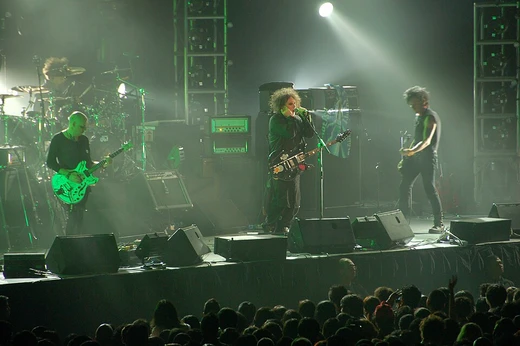
- Several of the band's most physically demanding live performances involve Smith pressing his face into the crowd or collapsing to the floor, gestures fans interpret as the physical release of everything the 'Headmaster'
- The Cure's album artwork frequently features institutional or quasi-institutional settings—corridors, doorways, glass partitions—reinforcing the sense of a protagonist perpetually on the wrong side of a closed door.
More in Lore & Symbolism
Elsewhere in the The Cure universe
Spotted an error? Know more?
This is a living reference — every entry is fact-audited, and reader corrections feed straight into our audit queue. Suggest an edit · See this site's audit record