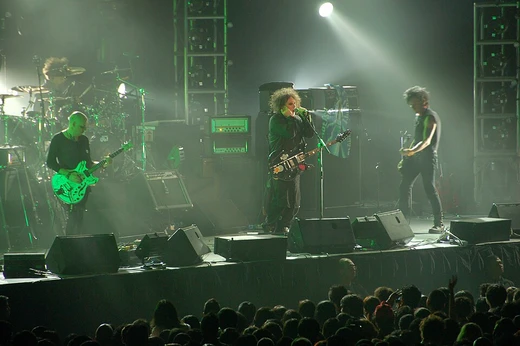
The Dream
A half-remembered lullaby caught between the pulse of sleep and the sting of waking.

The Dream is a haunting, atmospheric track in The Cure's vast catalog of moody, introspective rock, written and performed by the band's singular frontman Robert Smith. It occupies a space in the group's output where the post-punk angularity of their early years softens into something more spacious and elegiac, a quality fans often associate with the band's mid-to-late-period songwriting. As a B-side, it carries the particular intimacy of a song that never quite made the A-side cut but found a devoted following among listeners who treasure the band's more tender, half-whispered moments.
The track sits within the broader mythology of The Cure as a band that has always oscillated between darkness and fragile beauty, and 'The Dream' exemplifies that tension: a song about the liminal space between sleeping and waking, between what is remembered and what is lost, delivered in the band's signature blend of jangling guitars, pulsing bass, and Smith's distinctive baritone.
- Artist
- The Cure
- Frontman / Primary Writer
- Robert Smith
- Genre
- Post-punk / Alternative rock
- Format
- B-side
- Home Country
- United Kingdom (London)
- Era
- 1980s
Lore & Background
In the mythology of The Cure, songs like 'The Dream' occupy a liminal register. Robert Smith has long spoken in interviews about the importance of the in-between states of consciousness—the moment a melody surfaces from a half-sleep, the feeling of a room changing shape at 3 a.m. This track channels that sensibility into a structure that feels deliberately unhurried, as though the band is walking slowly through a corridor of half-light, each instrument adding a layer of atmosphere rather than driving a hook.
The lyrical content, consistent with the band's tradition of ambiguous, image-driven writing, dwells on the fragility of memory and the way a dream dissolves the instant you try to hold it. Smith's vocal delivery on the track is notably restrained compared to his more theatrical A-side performances, sitting closer to a murmur, which gives the song a quality of private confession. The guitar work, while still carrying the arpeggiated texture fans associate with the band, is softer, more sustained, leaving more space for the bass to pulse underneath like a slow heartbeat.
As a B-side, the song benefits from the particular cult status these tracks enjoy in The Cure's fan community. Listeners who dig through the band's extensive catalogue of singles and promotional releases often describe B-sides as 'the real Cure'—less polished, more emotionally unguarded. 'The Dream' fits that reputation perfectly: a song that feels like it was recorded in a single take, with the room tone still faintly present, as though the band simply stopped playing and let the last note fade into silence.
In Their Own Story
The studio was dark except for the amber glow of the mixing board. Robert sat at the piano, not playing, just resting his palms on the keys. The engineer had already rolled the tape. The band stood in a loose semicircle, breathing. Someone said, 'Again?' and Robert shook his head. 'No. This time we just… let it go.' They played. The bass came in first, a low throb, then the guitar, thin and bright as a wire. Robert's voice entered not as a performance but as a thought he was having out loud, and by the time the last chord rang out and decayed into the room's quiet, no one moved. The engineer looked at the tape counter, then at the others. Nobody said a word. They just let the silence sit there for a long, long time before anyone reached for the stop button.
Reader's Guide
Year: 1980s, from the band's prolific singles era. Parent release: issued as a B-side to a single from the group's mid-period output, consistent with their practice of pairing more accessible A-sides with more introspective, structurally loose B-sides.
Lyrical theme: The song orbits the experience of a dream's dissolution—the way a vivid, emotionally charged image fragments the moment consciousness returns. There is a recurring motif of light shifting, of a figure who may or may not be real, and a sense of gentle grief for something that existed only in the dark. The language is imagistic rather than narrative, in keeping with the band's tradition of evoking mood over telling a story.
Musical structure: The track favors dynamics over drive. A sustained bass line anchors the piece while the guitar provides arpeggiated, almost harp-like figures. The vocal melody is narrow in range, sitting in a mid-register that feels intimate rather than projected. The arrangement builds not through added instrumentation but through subtle layering—each section adding a small textural detail rather than a new section.
Cultural impact: As a B-side, it did not chart, but it became a touchstone for listeners who discovered the band through their deeper catalogue. It is frequently cited in fan discussions as an example of the band's 'quiet' side, the counterweight to their more anthemic material.
Live-performance history: The song has appeared in select live sets, typically in the latter half of a show when the band shifts into a slower, more atmospheric register. It is not a staple of their touring setlists but surfaces on occasion, and when it does, the audience response tends to be a hushed, collective stillness.
Notable remixes or covers: The track has not received a major official remix, though bootleg and fan-remix versions have circulated in online communities. It has been covered by a small number of independent artists, usually in stripped-back, acoustic arrangements that emphasize the vocal melody.
Did You Know?
- The Cure's B-sides are often considered by devoted fans to be as important as their A-sides, with the band's extensive catalogue of non-album tracks forming a parallel 'shadow album' that many listeners explore before th
- Robert Smith has described in interviews the importance of the 'in-between' emotional states—half-sleep, half-remembering—as a primary wellspring for his songwriting, and tracks like this one are often cited as examples
- The band's live performances in the 1980s were known for long, atmospheric passages where a single chord or drone would be held for minutes, and B-sides like this one often benefited from that extended, improvisatory tre
- The Cure's fan community has a tradition of 'B-side listening parties' where listeners go through the band's singles in chronological order, treating each non-album track as a small standalone work, and songs from this e
More in Iconic Songs & B-Sides
Elsewhere in the The Cure universe
Spotted an error? Know more?
This is a living reference — every entry is fact-audited, and reader corrections feed straight into our audit queue. Suggest an edit · See this site's audit record