Alternative Rock Mainstream (1992-1993)
The Cure's bittersweet pop triumph that conquered the world.

The Alternative Rock Mainstream era (1992-1993) marks a pivotal moment when The Cure's dark, introspective sound broke into the global pop consciousness. Following the massive success of their 1989 album 'Disintegration,' the band faced the challenge of following a masterpiece while maintaining their artistic integrity. This period saw Robert Smith and company embrace a more accessible, guitar-driven sound that retained their signature melancholy but with brighter production and more direct songwriting, resulting in their highest-charting commercial success.
- era
- 1992-1993
- musical_style
- Alternative rock, pop rock, dream pop
- key_album
- Wish
- notable_singles
- Friday I'm in Love, High
- cultural_impact
- Brought gothic alternative rock to mainstream radio and MTV
- lineup
- Robert Smith, Simon Gallup, Porl Thompson, Boris Williams, Perry Bamonte
Lore & Background
In 1992, The Cure released 'Wish,' an album that distilled their gothic romanticism into shimmering pop anthems. The era's sound was defined by jangly guitars, layered synths, and Smith's distinctive baritone, creating a paradox of upbeat melodies wrapped in lyrical longing. Songs like 'Friday I'm in Love' became unlikely radio staples, proving that melancholy could be commercial without losing its soul. The band's visual aesthetic softened slightly—Smith's smeared lipstick and wild hair remained, but the wardrobe incorporated brighter colors and more playful elements, reflecting the album's bittersweet optimism.
In Their Own Story
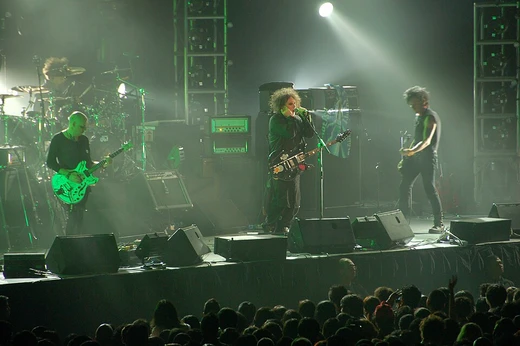
The rain had stopped by the time the band took the stage at a packed festival in 1992. Robert Smith stepped into the spotlight, his guitar slung low, and launched into the opening chords of 'High.' The crowd—a sea of black-clad fans mixed with curious newcomers—sang along to every word. For a moment, the boundary between underground and mainstream dissolved. Smith closed his eyes, letting the music wash over him, knowing that this era would define The Cure for a generation who discovered them through MTV and radio, yet still carried the weight of their earlier darkness.
Reader's Guide
Sonic characteristics: Jangling, clean guitar arpeggios (often in open tunings), prominent bass lines, layered synthesizers, and a crisp, polished production that contrasted with the murky reverb of earlier albums. Drums were punchy and rhythmic, with Boris Williams' precise fills driving the pop-oriented tracks. Visual aesthetic: Robert Smith's iconic smeared red lipstick and eyeliner remained, but his hair was often teased into a wild, voluminous mess rather than the spiky punk look. Band members wore a mix of thrift-store finds and deliberately disheveled suits, with occasional bursts of color (pink, yellow) breaking the all-black palette. Lyrical themes: Love as both ecstasy and agony, the passage of time, fleeting happiness, and the tension between hope and despair. Songs like 'Friday I'm in Love' celebrated simple joy, while 'From the Edge of the Deep Green Sea' explored obsessive desire. Cultural impact: The era brought alternative rock to mainstream audiences without diluting its essence, influencing a wave of 1990s bands who blended dark lyrics with pop hooks. It also cemented The Cure's status as MTV staples and festival headliners.
Did You Know?
- The album 'Wish' entered the Billboard 200 at number two and debuted at number one on the UK Albums Chart.
- The music video for 'Friday I'm in Love' features the band in a series of whimsical, color-saturated scenes, a deliberate departure from their earlier gothic visuals.
- The song 'High' was inspired by a dream Robert Smith had about flying over a landscape.
More in Eras & Musical Styles
Elsewhere in the The Cure universe
Spotted an error? Know more?
This is a living reference — every entry is fact-audited, and reader corrections feed straight into our audit queue. Suggest an edit · See this site's audit record