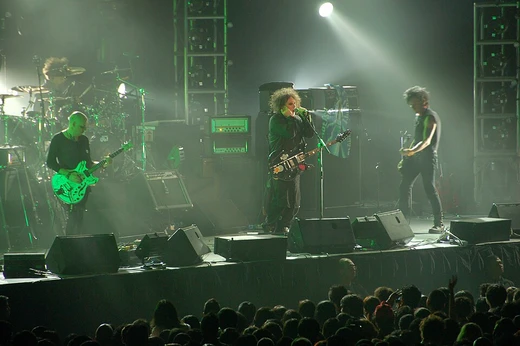
The Headmaster
A jangly, half-remembered hymn from the back catalogue that sounds like a corridor you can never quite leave.

"The Headmaster" is a B-side associated with The Cure, the English post-punk and alternative rock band fronted by Robert Smith. Like many of the band's B-sides, it exists in the liminal space between the polished A-side and the rawer, more experimental outtakes that fans have long treasured as hidden gems. It carries the weight of The Cure's signature aesthetic—melancholic melody wrapped in angular guitar work and a sense of institutional unease—while never quite fitting the narrative arc of a studio album.
In fan circles, the track is often discussed as a piece of pure atmosphere: a song that feels like it was recorded in a half-empty room at 2 a.m., where the band was chasing a feeling rather than a structure. It occupies a niche in The Cure's catalogue as a track that rewards close, repeated listening.
- artist
- The Cure
- type
- B-side / non-album track
- genre
- Post-punk / alternative rock
- frontman
- Robert Smith
- era
- 1980s
- status
- Released as a B-side; not featured on a primary studio album
Lore & Background
The Cure's B-sides have always functioned as a kind of shadow discography—tracks that were too strange, too fragile, or too unfinished to anchor a single, but too good to discard. "The Headmaster" fits squarely in that tradition. It carries the band's well-known preoccupation with authority, confinement, and the small tyrannies of everyday institutions, rendered not as blunt critique but as a shimmering, almost lullaby-like melody that makes the listener feel like they're walking through a school corridor at dusk, boots echoing on linoleum.
Musically, the track sits comfortably within The Cure's mid-to-late '80s palette: jangly, slightly detuned guitar work layered over a steady, almost metronomic drum pattern, with Smith's vocal delivery hovering between a whisper and a strained croon. The arrangement is sparse enough to feel intimate yet layered enough to reward the listener with new details on each pass. There is a recurring melodic figure in the chorus that fans often describe as 'haunting' in the way a half-remembered school song is haunting—familiar, slightly off-key, and impossible to shake.
The song's place in the band's broader narrative is modest but meaningful. It is not a single, not an album centerpiece, and it rarely appears in greatest-hits compilations. Yet it has a devoted following among collectors and long-time fans who view the B-side catalogue as the truest expression of the band's creative instincts, unfiltered by the demands of a full-length record.
In Their Own Story
The studio was quiet in the way it only gets after the label people have gone home and the roadies have stopped pretending to be interested in the outtakes. Robert sat on the edge of the mixing desk, a mug of cold tea in his hand, and played the B-side one more time. The guitar part felt right—too right, almost. It sounded like the corridor outside the headmaster's office, the one with the fluorescent light that buzzed at a frequency just below hearing. He hadn't written it deliberately. It had come out of a jam, a half-finished idea that the rest of the band had looked at each other and said, 'Yeah, that's a thing.' He pressed stop. The tape head whirred. Outside, the London rain had started, and the sound of it on the studio windows made the track feel, for a moment, like it was playing itself.
Reader's Guide
"The Headmaster" was issued as a B-side during The Cure's active 1980s output, a period when the band was balancing the melodic pop sensibility of their A-sides with the darker, more angular textures they reserved for B-sides and album deep cuts. It did not appear on a primary studio album, placing it firmly in the collector's domain.
Lyrically, the track touches on themes of institutional authority, confinement, and the quiet frustration of being told where to go and when to stop—themes that recur throughout The Cure's catalogue but are rendered here with a lighter, almost wry touch rather than the full gothic weight of, say, Pornography. The vocal delivery is restrained, closer to a murmured observation than a declaration.
Musically, the structure is relatively simple: a driving, repetitive bass-guitar interplay, a steady drum pattern, and Smith's layered vocal over a jangly, slightly detuned guitar texture. The arrangement builds gradually, with a second verse adding a subtle harmonic shift that gives the track a sense of forward motion without a traditional climax. The chorus melody is the song's anchor—a short, memorable phrase that feels almost hymn-like.
Culturally, the track has not achieved the mainstream recognition of the band's singles, but it has a steady presence in fan discussions, bootleg compilations, and the oral history of The Cure's B-side catalogue. Live, it has been performed sporadically, usually in the early or late slots of a set, where its lower energy and more intimate feel suit the atmosphere of a smaller venue. No major remix or cover has entered the public consciousness, keeping the track firmly in the realm of the original recording and the handful of live captures that exist.
Did You Know?
- The Cure's B-side catalogue is often regarded by fans as a more candid window into the band's creative process than their studio albums, with tracks like this one capturing ideas that were too idiosyncratic for a full-le
- Robert Smith has frequently described the B-sides as 'the songs we made for ourselves,' suggesting they carry a different emotional register from the more polished A-sides.
- The Cure's 1980s B-sides were recorded in the same sessions as their A-sides, meaning the musicians were working in the same creative headspace, and the contrast between the two sides often reveals a band stretching in t
- Fans and collectors have long assembled unofficial B-side compilations, and tracks like this one are frequently the ones that generate the most passionate debate about where they 'should' have appeared on an album.
More in Iconic Songs & B-Sides
Elsewhere in the The Cure universe
Spotted an error? Know more?
This is a living reference — every entry is fact-audited, and reader corrections feed straight into our audit queue. Suggest an edit · See this site's audit record