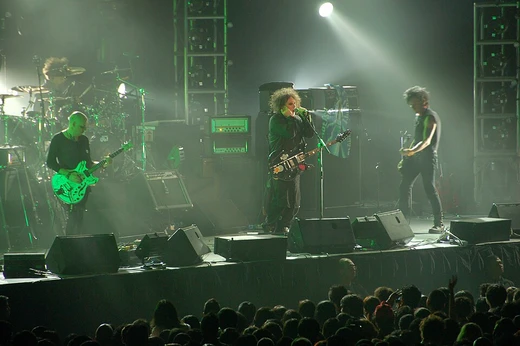
The Pornography Tour (1982)
Black clothes, broken bones, and a wall of sound in a room that smelled of sweat and incense.

The Pornography Tour was The Cure's 1982 UK live run in support of their fourth studio album, *Pornography*—the band's darkest and most sonically dense record to that point. Far from the stadium spectacles they would later command, this was a scrappy, intimate circuit of small clubs and mid-size halls where a handful of thousand or fewer fans packed in to witness Robert Smith's increasingly unhinged physical performances and the band's wall of droning, minor-key guitars.
For fans, the tour represents a pivotal 'in-the-trenches' moment: The Cure were still a cult act, building a reputation through word-of-mouth and the sheer visceral intensity of their live shows rather than commercial machinery. The Pornography Tour cemented the image of Smith as a thrashing, self-destructive frontman and the band as purveyors of gothic, post-punk despair, laying the groundwork for the larger arenas they'd fill just a couple of years later.
- Tour
- The Pornography Tour
- Year
- 1982
- Album supported
- Pornography (1982)
- Primary region
- United Kingdom
- Venue scale
- Clubs and small-to-mid-size halls
- Frontman
- Robert Smith
- Band status at the time
- Emerging cult act, pre-stadium era
Lore & Background
By the time *Pornography* hit the shelves in late 1982, The Cure had already shed their janglier, more accessible early sound and committed fully to a palette of dissonance, droning bass, and Smith's anguished baritone. The tour that followed was less a 'show' in any polished sense and more a collective exorcism. The band played in venues where the stage was barely wider than a dining table, the lighting rig a couple of follow-spots and a haze machine, and the sound system a PA bolted to the back wall. Audiences of a few hundred pressed against the barrier, and the atmosphere was almost religious in its intensity.
Robert Smith's stagecraft during this period is legend among fans. He would hurl himself across the stage, thrash his guitar, dive at the audience, and occasionally injure himself—bruised ribs, split lips, a general air of controlled self-harm that the press latched onto with glee. The rest of the band provided a wall of interlocking guitar and bass tones while Lol Tolhurst's drums drove the machinery. There was no pyrotechnics, no video screens, no elaborate staging. The 'set design' was the band's all-black attire, Smith's darkened eyes, and the sheer physicality of the performance.
For the fans who attended, the Pornography Tour shows became touchstones—a shared, almost conspiratorial experience of witnessing a band at a raw, vulnerable peak. Many of those attendees would go on to become the core of The Cure's lifelong fanbase, carrying memories of a mosh-pit-sized room and a frontman who seemed to be tearing himself apart in real time.
In Their Own Story
The venue was a converted warehouse on a damp November night. The air inside was thick with cigarette smoke and the metallic tang of the PA feedback that never quite went away. Robert Smith stood at the mic, his white hair a wild halo, his eyes ringed in black. He said nothing. He just raised his guitar, and the first chord of the next song hit the room like a fist through wet cardboard. Someone in the front row screamed—not in fear, but in recognition, as if the sound had reached into their chest and pulled something loose. Smith thrashed, leapt, slammed his guitar neck against the amp, and the crowd surged forward like water over a weir. By the final song, the barrier had given way, and for three minutes it was just bodies, noise, and the smell of spilled beer on concrete. When the last note decayed, the silence that followed was the loudest thing in the room.
Reader's Guide
The Pornography Tour ran through the latter part of 1982 across the United Kingdom, threading through small clubs, university halls, and mid-capacity venues in London, Manchester, and other major cities. The band was still too small for arenas; typical capacities ranged from a few hundred to perhaps two or three thousand. The setlist revolved heavily around *Pornography* material—long, droning tracks like 'A Forest' and 'Shots of Love'—interspersed with select earlier songs to keep the setlist from running past an hour. Stage design was essentially nonexistent: a bare platform, a basic lighting rig, and the band in their signature all-black attire. Robert Smith's physical performance—leaping, thrashing, occasionally crashing into equipment or the audience—was the main 'production' element.
Memorable firsts for this era include the band's growing reputation for chaotic live shows that drew both praise and concern from the press. The tour also marked a period where The Cure's audience was still very much a niche, post-punk crowd, and the shows felt like closed, communal events rather than commercial spectacles. By the time the tour wound down, word-of-mouth had begun to push The Cure toward the larger venues they'd fill during the subsequent *Faith* and *Kiss Me, Kiss Me, Kiss Me* cycles.
Did You Know?
- Robert Smith's physical stage antics during this era—leaping, thrashing, crashing into the audience—became a recurring press talking point and helped cement his image as a 'self-destructive' frontman, a reputation that f
- The Pornography Tour took place when The Cure were still a relatively small, cult-level act; the venues they played were often the same clubs that hosted other post-punk and gothic bands of the early '80s UK scene.
- The album *Pornography*, which the tour supported, is widely regarded as The Cure's darkest and most musically complex record, and the live performances of its longer, more atmospheric tracks were a highlight for fans of
- The all-black aesthetic and dark-makeup look that defined The Cure's visual identity was fully established by this period, and the Pornography Tour shows are often cited by fans as a high-water mark for that look in a li
More in Tours & Live Performances
Elsewhere in the The Cure universe
Spotted an error? Know more?
This is a living reference — every entry is fact-audited, and reader corrections feed straight into our audit queue. Suggest an edit · See this site's audit record