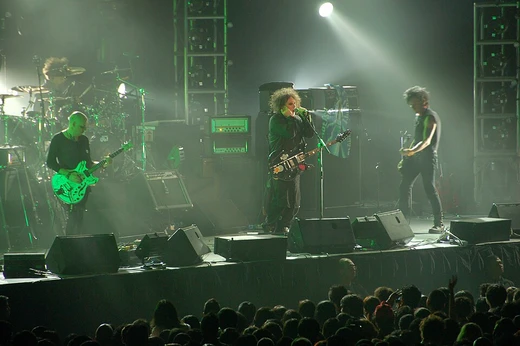
Disintegration
The self unravels, note by note, in the most beautiful ruin The Cure ever built.

Disintegration is the title track and lead single from The Cure's 1989 album of the same name, written and performed by Robert Smith. It stands as one of the band's most searing and recognizable compositions—a slow-burning, atmospheric piece of gothic rock that channels existential dread, the erosion of identity, and the terrifying sensation of the self coming apart at the seams. In the broader arc of The Cure's catalogue, it marks the apex of their darkest, most introspective period, following the emotional turbulence of the 1980s and crystallizing the band's signature blend of melancholy and grandeur.
The song's cultural footprint extends well beyond the album: its music video, its live performances, and its recurring presence in film, television, and fan culture have made it a touchstone for anyone drawn to The Cure's shadowy, poetic world. It is the track that, for many listeners, defines what The Cure sound like at their most devastating and beautiful.
- Artist
- The Cure (Robert Smith)
- Year of release
- 1989
- Parent album
- Disintegration (9th studio album)
- Genre
- Gothic rock / Post-punk / Dark alternative rock
- Lyrical theme
- Loss of identity, existential dissolution, emotional collapse
- Notable visual
- Music video featuring Smith in a white suit within a dark industrial landscape
Lore & Background
In the mythology of The Cure's discography, Disintegration occupies a singular place. After the raw emotional honesty of earlier records and the synth-laden experiments of the mid-80s, the band returned to a stripped-down, guitar-and-bass-driven sound that felt almost ritualistic. Robert Smith has spoken in interviews about the song capturing a period of profound personal uncertainty—a feeling that the boundaries of the self were dissolving, that the familiar architecture of identity was crumbling. The lyrics, sparse and repetitive in their key phrases, mirror that dissolution: the same images of loss and dislocation circle back like a mind unable to hold a coherent narrative.
Musically, the track is a masterclass in tension and release. The opening is deceptively quiet, a shimmering guitar texture over a pulsing bass line that feels like a slow heartbeat. As the song progresses, layers accumulate—drums lock in, the guitar thickens, and the chorus arrives with a weight that feels almost architectural, as though the band is constructing a cathedral out of grief. The production is dry and immediate, letting the rawness of the performance breathe without the polish of the era's more synthesized alternative rock.
The music video, shot in a stark industrial environment, became inseparable from the song in the public imagination. Smith, clad in a white suit that reads as both funereal and defiant, moves through a landscape of rust, concrete, and shadow. The imagery of a lone figure performing a slow, almost choreographed dance of collapse in a decaying space gave the song a visual grammar that fans have referenced, imitated, and reinterpreted for decades. It cemented the idea that The Cure's darkness was not mere aesthetic but an emotional truth rendered in concrete and light.
In Their Own Story
The warehouse had no name, only a number stencilled in faded yellow on a corrugated door that no one remembered opening. Inside, the air tasted of iron filings and old rain. He stood at the centre of the floor, arms slightly raised, fingers splayed as though trying to hold water that kept slipping through his grip. The bass note came from everywhere and nowhere—a low, subsonic thrum that he felt in his molars before he heard it. Each repetition peeled something back. A memory. A name. The particular way the light used to fall through the kitchen window in a house he could no longer locate. He danced, though the word was too generous. He swayed, he staggered, he pressed his palms flat against the cold concrete as if the ground might tell him who he was. The guitar swelled above him like a tide he could not outrun, and for a moment—just a moment—the architecture of his days held, and then it did not, and the white of his shirt was the only thing left that looked like a person.
Reader's Guide
Year: 1989. Parent album: Disintegration, The Cure's ninth studio album, released in October of that year.
Lyrical theme: The song circulates around the idea of the self breaking down—identity, memory, and emotional continuity dissolving under pressure. Key images of loss, repetition, and the inability to hold onto a coherent sense of who one is give the lyrics a hypnotic, almost incantatory quality. It is less a narrative than a state of being, rendered in short, circling phrases.
Musical structure: The track opens with a sparse, atmospheric guitar figure over a driving, repetitive bass line that establishes the song's pulse. Drums enter gradually, adding weight without rushing the tempo. The verse sections remain relatively restrained, building tension through layering rather than melodic complexity. The chorus arrives with a fuller, more anthemic guitar texture and a vocal delivery that sits between a whisper and a shout. The song follows a verse-chorus structure with a bridge section that strips back to near-silence before the final chorus, creating a sense of collapse and reconstruction.
Cultural impact: Disintegration became one of the defining tracks of late-80s gothic and alternative rock. Its music video, its live performances, and its use in film and television soundtracks have kept it in continuous cultural circulation. For a generation of listeners, it remains the essential entry point into The Cure's darker catalogue.
Live-performance history: The song has been a staple of The Cure's setlists since 1989, performed in virtually every major tour and festival appearance. Live versions often extend the intro and allow the band to build the chorus more slowly, creating a communal, almost liturgical experience. Robert Smith's physical performance during the track—slow, deliberate, sometimes near-still—has become a recognizable part of the song's identity.
Notable remixes or covers: The track has been remixed for various compilation and remix releases over the years, and has been covered by a range of alternative and indie artists, though it remains most powerfully associated with The Cure's original 1989 recording.
Did You Know?
- The song's title and central metaphor—disintegration—was chosen by Robert Smith to capture a specific emotional state of the late 1980s, a period he has described in interviews as one of deep personal uncertainty and sel
- The music video's industrial setting and Smith's white suit created a visual language that became one of the most imitated and referenced images in gothic and alternative music video history.
- The bass line in Disintegration is deliberately simple and repetitive, a compositional choice that mirrors the lyrical theme of the mind circling the same thought without resolution, and it has become one of the most rec
- The album Disintegration was recorded and produced with a deliberately dry, immediate sound, a conscious departure from the more layered and synth-heavy production of The Cure's mid-1980s work, reflecting a desire to ret
More in Iconic Songs & B-Sides
Elsewhere in the The Cure universe
Spotted an error? Know more?
This is a living reference — every entry is fact-audited, and reader corrections feed straight into our audit queue. Suggest an edit · See this site's audit record