The Forest and Trees
Where the mind goes to seed and the heart grows bark.

The Forest and Trees is a recurring symbolic motif in The Cure's visual and lyrical universe, representing the tension between nature's wild, untamed growth and the human desire for order, escape, or entrapment. It appears most prominently in the album *Disintegration* (1989), where forests evoke melancholy, isolation, and the passage of time, often contrasting with solitary trees that stand as markers of memory or loss. This imagery is central to the band's gothic romanticism, blending pastoral beauty with a sense of decay.
- Role
- Recurring symbolic motif in lyrics and album artwork
- Affiliation
- The Cure's visual identity, especially *Disintegration* era
- First appears
- Early albums like *Seventeen Seconds* (1980) and *Faith* (1981)
- Status
- Active in fan interpretation and band iconography
Lore & Background
In The Cure's world, forests are liminal spaces where time slows and emotions root deeply. The band's frontman Robert Smith often uses trees as metaphors for endurance and isolation—a lone tree can symbolize a person standing against the elements, while a forest suggests collective mystery or the overwhelming complexity of the mind. The album *Disintegration* features a forest on its cover, with a solitary figure walking away, reinforcing themes of departure and fading connections. This imagery recurs in songs like 'The Same Deep Water as You' and 'Plainsong,' where natural landscapes become emotional landscapes.
In Their Own Story
A gray mist clings to the pines as I walk the path between the trees. Their branches intertwine overhead, blocking the sky, and I remember how we used to run here as children—laughing, fearless. Now the forest feels different, like it's holding its breath. I stop at the old oak where we carved our names; the bark has healed over, the letters barely visible. I press my palm to the trunk, feeling the damp moss, and I know this place will outlast us all, silent and patient, waiting for the next wanderer to get lost.
Reader's Guide
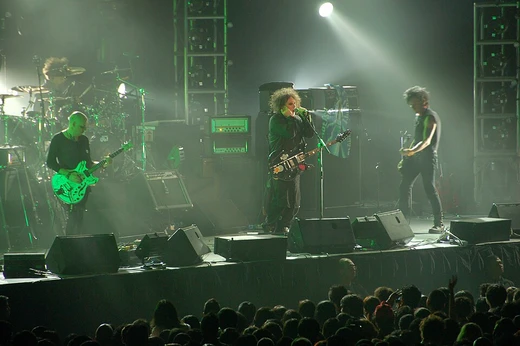
The Forest and Trees in The Cure's work often explore the duality of nature as both sanctuary and prison. In songs like 'A Forest' (1980), the imagery of running through trees captures a chase for something unattainable—a metaphor for desire or memory that slips away. The band's gothic aesthetic amplifies this: forests are never idyllic but tangled, dark, and dripping with rain, reflecting the emotional weight of their lyrics. Fans interpret this as a symbol of the subconscious, where every tree is a thought, and the forest is the mind's labyrinth. The lone tree, meanwhile, stands for resilience or loneliness, as seen in the *Disintegration* cover art. This motif also connects to the band's live performances, where Smith's stage presence among floral and arboreal decorations creates a dreamlike, immersive atmosphere. Ultimately, the forest is a canvas for The Cure's exploration of time, loss, and the natural world's indifference to human pain.
Did You Know?
- The album *Disintegration* was not originally titled *The Same Deep Water as You*; that is a song on the album, but the forest imagery on the cover became iconic.
- Robert Smith has said that 'A Forest' was inspired by a recurring dream of running through a dark wood.
- The forest motif appears in The Cure's music videos, such as 'Lullaby,' where trees and shadows create a claustrophobic fairy-tale setting.
- Fans often associate the forest with the band's early 'cold wave' period, where sparse instrumentation mirrored the starkness of bare branches.
- On the *Disintegration* cover, the figure walking away is actually a photograph of Robert Smith's own back, taken in a forest near his home.
More in Lore & Symbolism
Elsewhere in the The Cure universe
Spotted an error? Know more?
This is a living reference — every entry is fact-audited, and reader corrections feed straight into our audit queue. Suggest an edit · See this site's audit record