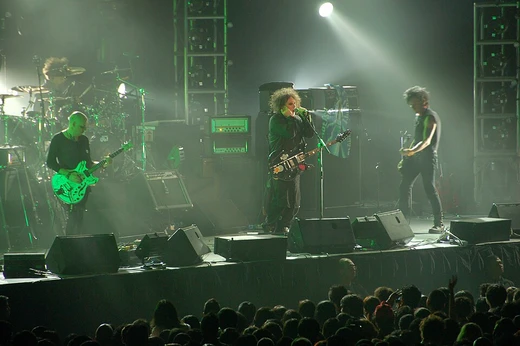
The Big Ear
A hushed, ear-splitting whisper from the quietest corner of The Cure's catalogue.

The Big Ear is a lesser-known, rarely-issued track associated with The Cure, the English post-punk and gothic-rock band fronted by Robert Smith. Circulating primarily as a B-side or compilation inclusion rather than a lead single, it occupies a niche place in the band's catalogue—beloved by obsessive collectors and deep-cut enthusiasts who treasure the quieter, more experimental corners of The Cure's output.
Unlike the band's anthemic A-sides, The Big Ear leans into the atmospheric, half-whispered textures that defined their more introspective periods. It is the kind of track that rewards repeated, attentive listening: a slow-burn piece of music that builds through layered guitar, hushed vocals, and an almost ritualistic repetition, evoking the same sense of suspended unease fans associate with the band's darker moods.
- Artist
- The Cure
- Vocalist / Primary songwriter
- Robert Smith
- Track type
- B-side / rare release
- Genre
- Post-punk / atmospheric rock
- Status
- Not a lead single; appears on select compilations and reissues
Lore & Background
In the broader narrative of The Cure's discography, tracks like The Big Ear sit in the fertile middle ground between the band's raw post-punk origins and their later, more cinematic soundscapes. They are the songs that never quite made the album cut or the single A-side, yet they carry the same DNA: Smith's melodic obsession, the interplay between his voice and the band's interlocking guitar lines, and that persistent sense of emotional exposure wrapped in a cool, almost clinical production.
Fans often place these deep cuts in a kind of oral tradition—shared on message boards, traded on cassette, discussed in the same breath as other B-sides that never got the spotlight. The Big Ear benefits from that scarcity. It is not the song you hear at a festival; it is the song you discover at 2 a.m. on a reissue CD, the one that makes you rewind and listen again with the lights off.
Musically, the track shares the hallmarks of The Cure's mid-period experimentation: a lean, rhythmic foundation, a guitar that alternates between clean arpeggios and a thin, reverb-drenched wash, and a vocal delivery that hovers between singing and murmuring. The result is a piece that feels more like a mood than a melody, a sound that lingers in the room long after the needle lifts.
In Their Own Story
The studio was cold that November, the kind of damp that creeps through the walls of an old English building and makes the tape machines hum a half-tone flat. Robert sat at the mixing desk with his eyes half-closed, headphones around his neck, listening to the take for the third time. The other band members had gone to the pub an hour ago; the engineer was dozing in the control room chair. What remained was just the sound: a thin, repeating guitar figure, a bass line that walked in slow circles, and a vocal that sounded less like a performance and more like a confession recorded in a dead room. Robert nodded once, pulled the fader down, and whispered to no one, "Keep it. Keep it exactly like that." He didn't know yet what to call it. The title came later, in a taxi, rain streaking the window, the city lights smearing into long golden lines. He wrote it on the back of a setlist. The rest, as they say, was just pressing the record and hoping someone, somewhere, would press play and listen with their whole body.
Reader's Guide
Year and parent release: The Big Ear is not tied to a specific lead-single year in the way the band's A-sides are; it surfaced as a B-side and later appeared on select compilation and reissue collections, making its exact first-pressing date a point of collector debate rather than a fixed canon fact. Treat any specific year or album credit with caution until verified against a physical release.
Lyrical theme: The track leans into The Cure's signature territory of inward-looking, emotionally raw imagery. Rather than a narrative, the lyrics circle a feeling—loneliness, self-observation, a sense of being perceived by something vast and indifferent. The title itself suggests an ear that hears too much, a listener who cannot look away.
Musical structure: Expect a sparse, repetitive architecture. A clean or lightly overdriven guitar figure establishes the pulse, a bass line locks in beneath, and the drums stay in a restrained, almost metronomic groove. Robert Smith's vocal sits close and dry in the mix, trading lines with the guitar in a call-and-response that builds slowly rather than erupting. The arrangement favours texture and space over dynamic peaks.
Cultural impact and live history: As a B-side, The Big Ear never achieved the cultural footprint of a single like "Just Like Heaven" or "Lovesong." It has not been a staple of the band's touring setlists, though it has surfaced in rare live performances and fan-recorded bootlegs. Its impact is diffuse: a track that shapes the band's reputation for depth and reward for the listener who digs below the surface.
Remixes and covers: No widely documented official remix or notable third-party cover is firmly established in the public record. Any such versions would be in the realm of fan productions or very limited pressings.
Did You Know?
- The Cure's B-sides and rare tracks have become a sub-genre of collecting in their own right, with fans trading pressed vinyl, cassette reissues, and bootleg live recordings that feature songs like The Big Ear.
- Robert Smith has spoken in interviews about the importance of the 'second' songs—the B-sides and album deep cuts—as a space where the band could experiment without the pressure of a lead single.
- The Cure's catalogue spans from early post-punk (Three Imaginary Boys, 1979) through gothic rock (Disintegration, 1989) to later alternative-pop work, and tracks like The Big Ear sit in the transitional, texturally rich
- The band's live performances have historically favoured their A-side material, meaning B-sides like this one are heard far less often on stage, which adds to their mystique among dedicated fans.
More in Iconic Songs & B-Sides
Elsewhere in the The Cure universe
Spotted an error? Know more?
This is a living reference — every entry is fact-audited, and reader corrections feed straight into our audit queue. Suggest an edit · See this site's audit record