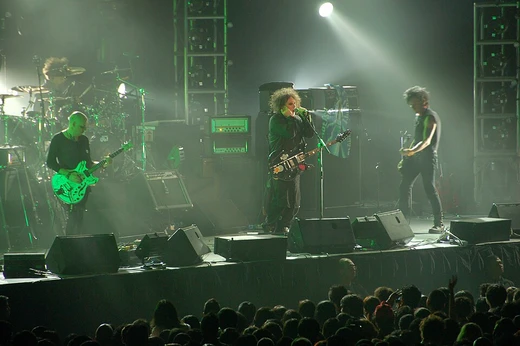
Electronic Experimentation
When drum machines learned to ache: the Cure's electronic reinvention.

The Electronic Experimentation phase doesn't just mark an evolution in The Cure's sound—it rewires it from the inside out. Between roughly 1984 and 1989, the band didn't merely add synthesizers and drum machines to their post-punk skeleton; they let those machines breathe alongside Robert Smith's guitar, creating a tension between cold precision and raw emotion. This period didn't abandon the band's signature gloom—it taught it to dance, layering brighter, more insistent rhythms over their familiar melancholy, and in doing so, it expanded their audience without ever selling out their artistic soul.
- Associated Albums
- The Head on the Door, Kiss Me, Kiss Me, Kiss Me, Disintegration
Lore & Background
This stylistic shift wasn't a sudden about-face but a slow, deliberate corrosion of old boundaries. The band, tired of the raw, live-wire energy of their early years, began to treat the studio as an instrument itself. Synthesizers weren't grafted onto the sound like prosthetic limbs; they were woven into the fabric, so that a sequencer's pulse could feel as intimate as a heartbeat. This era walks a tightrope between commercial polish and bruised introspection—tracks that could fill a dancefloor without losing the ache in their lyrics. Fans often describe this period as the sound of a gothic romance novel being read aloud in a neon-lit nightclub. The electronic elements didn't overwrite the band's identity; they layered it with chrome and glass. The result was a soundscape where programmed beats and human vulnerability cohabitated uneasily, creating a legacy that still hums through alternative music today.
In Their Own Story
The studio lights hummed low as Robert adjusted the knobs on the synthesizer, searching for a tone that sounded like rain against glass—but not just any rain; the kind that falls at 3 a.m. when you're waiting for a phone call that never comes. Outside, London slept under a gray sky, but inside, the rhythm section pulsed with mechanical precision, a drum machine ticking like a metronome with a broken heart. He layered a guitar riff over the electronic beat, watching the waveforms dance on the screen like ghosts in a machine. It was no longer just about noise; it was about texture, memory, and the cold comfort of machines mimicking human emotion in the quiet hours before dawn.
Reader's Guide
Sonic characteristics define this era by the seamless fusion of distorted guitars with shimmering synthesizer pads and sequenced basslines—think of it as a velvet glove wrapped around a steel fist. The rhythm section often relied on drum machines to create tight, danceable grooves, but the somber mood never fully lifted; it just learned to tap its foot. Visually, this period saw a transition from punk disarray to sharper fashion choices, including tailored suits and elaborate makeup that mirrored the polished sound—Smith's smeared lipstick and teased hair became as iconic as his guitar. Lyrical themes continued to explore isolation and longing, but now they were delivered with a melodic clarity that could slip into mainstream radio without losing their edge. Culturally, this experimentation acted as a bridge between the underground and the pop charts, proving that gloom could be both artful and accessible. The impact remains evident in how later bands—from Depeche Mode to Editors—learned to mix darkness with danceability. It proved that a group rooted in melancholy could embrace technology without losing their soul, creating a catalog that still resonates with listeners who appreciate the nuance of a synthesizer that sounds like it's crying. This phase demonstrated versatility, showing that electronic tools could enhance emotional depth rather than flatten it. The resulting albums—from 'The Head on the Door' to 'Disintegration'—remain celebrated for balancing innovation with the band's core gothic aesthetic, a tightrope walk that few have managed to repeat.
Did You Know?
- The band utilized drum machines on several tracks during this period to achieve consistent rhythmic precision, but they often ran those machines through guitar pedals to give them a warmer, more organic feel.
- This era coincided with the group achieving greater international chart success than in their early years—'Kiss Me, Kiss Me, Kiss Me' (1987) became their first Top 40 album in the U.S., peaking at No. 35.
- Robert Smith often described using synthesizers as a way to add color rather than replace guitars, comparing it to painting with a new shade of blue rather than throwing out the canvas.
- Several songs from this time—like 'Just Like Heaven' and 'Lovesong'—became staples of alternative radio playlists worldwide, proving that heartbreak could be both catchy and profound.
More in Eras & Musical Styles
Elsewhere in the The Cure universe
Spotted an error? Know more?
This is a living reference — every entry is fact-audited, and reader corrections feed straight into our audit queue. Suggest an edit · See this site's audit record