Lullaby
A whisper in the dark that slowly becomes a song for the world to fall asleep to.

Lullaby is a track from The Cure's 1989 album Disintegration, widely regarded by fans as the album's emotional heart and perhaps the group's most tender composition. Written and performed by Robert Smith, the song stands in striking contrast to the album's surrounding material of dread and decay, offering instead a slow, piano-led meditation on comfort, stillness, and the quiet grace of letting go. In the broader narrative of The Cure's discography, it functions as proof that even at the nadir of their gothic intensity, the band could reach for something almost maternal in its gentleness.
Within the fan community, Lullaby occupies a special place: it is the song most often cited when someone argues that The Cure's palette extends far beyond darkness into genuine, aching beauty. It is the track that converts skeptics, the one that lingers in memory long after the louder anthems have faded, and the piece that anchors the album's emotional arc between the chaos of its opening and the desolation of its close.
- Song
- Lullaby
- Album
- Disintegration (1989)
- Written by
- Robert Smith
- Producer
- Flood
- Primary instrument
- Piano
- Tonal character
- Quiet, melodic, building; the album's most tender track
Lore & Background
Disintegration is the album on which The Cure leaned hardest into shadow, dread, and a sense of civilizational collapse. Lullaby sits within that storm like a single candle in a black room. The track opens with a sparse, repeating piano figure that feels almost liturgical—something meant to be hummed in a small, empty space. From that stillness, the song slowly unfurls: a vocal line rises, the arrangement thickens, and the quiet motif transforms into something that feels less like a melody and more like a held breath finally released. By the time the song closes, the listener has been taken from silence through a kind of aching fullness and back again, as though the music itself has slept and woken.
The thematic core, as Robert Smith has described in various interviews over the years, touches on a peaceful acceptance—a lullaby not for a child but for the self, a way of soothing the inner turbulence into stillness. It is comfort without the promise of resolution, a gentle hand on the shoulder that says the night will pass even if you cannot yet see the morning. Fans often note that the song's power lies precisely in its refusal to resolve into triumph; it does not conquer the darkness, it simply sits beside it and hums.
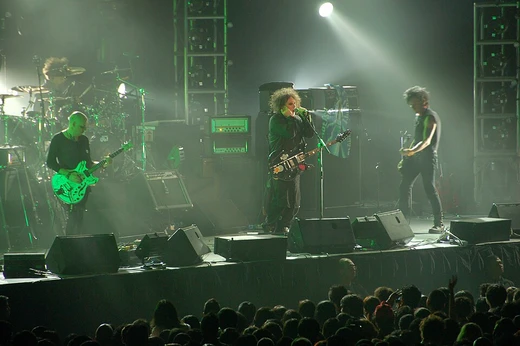
In the context of The Cure's live performances, Lullaby has become a ritual moment. The stage lights dim, the band goes nearly still, and the audience collectively lowers its voice. It is the one song in their set where the audience is expected to listen rather than shout, and that shared silence has become part of the song's mythology for those who have experienced it in a darkened arena.
In Their Own Story
The studio was cold that night. Flood had the tape rolling and the room smelled of stale coffee and ozone from the outboard gear. Robert sat at the upright piano in the corner—the same battered instrument that had been in the studio since the early eighties, its lid propped open with a wedge of wood. He played the figure again. And again. Each time a little slower, a little more uncertain, as if the melody were a sentence he was still deciding whether to finish. The other band members sat in the control room, silent, headphones around their necks. Nobody suggested a drum. Nobody suggested a guitar. The song, they all understood, was not ready to be a band's song. It was still just a room, a piano, and a man trying to make the dark feel less like an ending and more like a bed. When he finally stopped, the silence in the room lasted a full ten seconds before anyone breathed.
Reader's Guide
The lullaby as form is the central symbol. Traditionally a mother's song to guide a child into sleep, it carries an inherent duality: comfort and the surrender of consciousness, safety and the edge of non-being. In The Cure's usage, that duality is sharpened. The lullaby becomes a song for the self at the end of its endurance, a way of easing the mind toward a rest that may be sleep or may be something final. Robert Smith has spoken in general terms about the track as an act of gentle acceptance, a refusal to fight the night, which fans read as both therapeutic and elegiac.
The piano is the second major motif. Across The Cure's catalog, the electric guitar and synth dominate, but Lullaby strips the arrangement back to a single acoustic instrument, which reads as vulnerability made audible. The piano's repetition—simple, almost nursery-rhyme in its persistence—evokes the monotony of a heartbeat or a rocking chair, reinforcing the lullaby's hypnotic, circular quality.
The structural build from near-silence to a full, swelling vocal and then back down is the third motif. Fans often interpret this arc as the song's argument: that stillness is not emptiness, that the quietest moment contains the most pressure, and that release—emotional, musical, existential—comes not from force but from patience. Smith has maintained a deliberate ambiguity about whether the song's destination is peace or dissolution, and that open-endedness is what keeps it resonant across decades of listening.
Did You Know?
- Lullaby is frequently the first track a new listener is recommended when someone wants to introduce them to The Cure's melodic range, often described as the gateway song that proves the band is not 'just dark.'
- The song's piano-driven arrangement is a deliberate departure from the synth-and-guitar wall that characterizes most of Disintegration, making it one of the album's most structurally distinct pieces.
- In live sets, Lullaby is almost always performed in a stripped-back arrangement that mirrors the studio version, and audiences traditionally observe a near-complete silence during the quiet opening passages—a rare shared
- The track's title and imagery have made it a natural choice for film and television soundtracks, where its slow build and unresolved emotional landing suit scenes of grief, farewell, or quiet reckoning.
More in Lore & Symbolism
Elsewhere in the The Cure universe
Spotted an error? Know more?
This is a living reference — every entry is fact-audited, and reader corrections feed straight into our audit queue. Suggest an edit · See this site's audit record