Disintegration Era (1989)
The sound of falling apart done right — like a cathedral's ceiling giving way in slow motion, and you can't look away.

1989 gave us 'Disintegration,' and the stretch around it — what fans call the Disintegration Era — is where The Cure sounded most themselves. The records lean hard into layered synthesizers and stacked guitar parts, with Robert Smith writing about loss, time, and emotional decay in a way that reads like someone working through something very personal. Underneath, gothic rock, dream pop, and post-punk all braid together without a single seam showing. For a lot of people, this is the benchmark: the Cure at their most focused and unapologetic.
- Album
- Disintegration
- Release Year
- 1989
- Label
- Fiction Records
- Key Members
- Robert Smith, Simon Gallup, Porl Thompson, Boris Williams, Roger O'Donnell
- Musical Style
- Gothic rock, dream pop, post-punk
- Legacy
- Considered a landmark album of the 1980s
Lore & Background
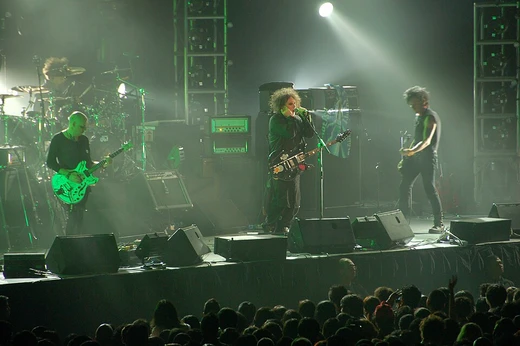
The Disintegration Era emerged from a period of personal turmoil for Robert Smith, who turned 30 and faced fears of aging and creative burnout. The album was recorded at Hook End Manor in England, a reportedly haunted mansion, which added to the atmospheric tension. Smith's lyrics delve into fractured relationships, mortality, and the passage of time, while the music swells with cavernous reverb, droning basslines, and orchestral synth pads. The band's live performances during this era were stark and emotionally charged, with Smith often appearing in smeared makeup and a black cloud of hair, embodying the album's melancholic spirit.
In Their Own Story
The rain fell in sheets against the manor's windows, each drop a tiny hammer on the glass. Inside, Robert sat alone in the control room, headphones clamped over his ears, listening to the same loop of a decaying chord for the hundredth time. The room smelled of damp wood and cigarette smoke. He closed his eyes and saw the faces of people he'd lost, moments that had slipped away like water through fingers. On the tape, a single piano note hung in the air, then dissolved into a sea of static. He pressed record again. Outside, a floorboard creaked — the ghost, or just the house settling? Either way, it found its way onto the track.
Reader's Guide
The sonic characteristics of the Disintegration Era are defined by a dense, layered production: prominent basslines, shimmering guitar arpeggios, and sweeping synthesizer pads create a vast, melancholic soundscape. Drums are often slow and deliberate, with heavy reverb. Vocals are delivered in a low, intimate register, often doubled or echoed. Visually, the aesthetic is dark and romantic: Robert Smith's iconic smeared red lipstick and black eyeliner, disheveled black hair, and loose, flowing black clothing. The album cover features a stark, faded image of a flower in decay, reflecting the themes of dissolution. Lyrical themes center on heartbreak, nostalgia, existential dread, and the fragility of love and memory. Songs like 'Pictures of You' and 'Lovesong' explore longing and devotion, while 'Fascination Street' and 'Disintegration' confront inner demons. Culturally, this era cemented The Cure as gothic rock icons and influenced countless bands in alternative, shoegaze, and post-punk. It remains a touchstone for emotional depth in music.
Did You Know?
- The album 'Disintegration' was originally titled after a line from a poem by Robert Smith.
- The band recorded much of the album in a reportedly haunted mansion, which some say influenced its eerie atmosphere.
- Despite its dark themes, 'Lovesong' was written by Robert Smith as a wedding gift for his long-term partner.
- The iconic cover art is a detail from a larger painting by artist Parched Art, depicting a wilting rose.
More in Eras & Musical Styles
Elsewhere in the The Cure universe
Spotted an error? Know more?
This is a living reference — every entry is fact-audited, and reader corrections feed straight into our audit queue. Suggest an edit · See this site's audit record